
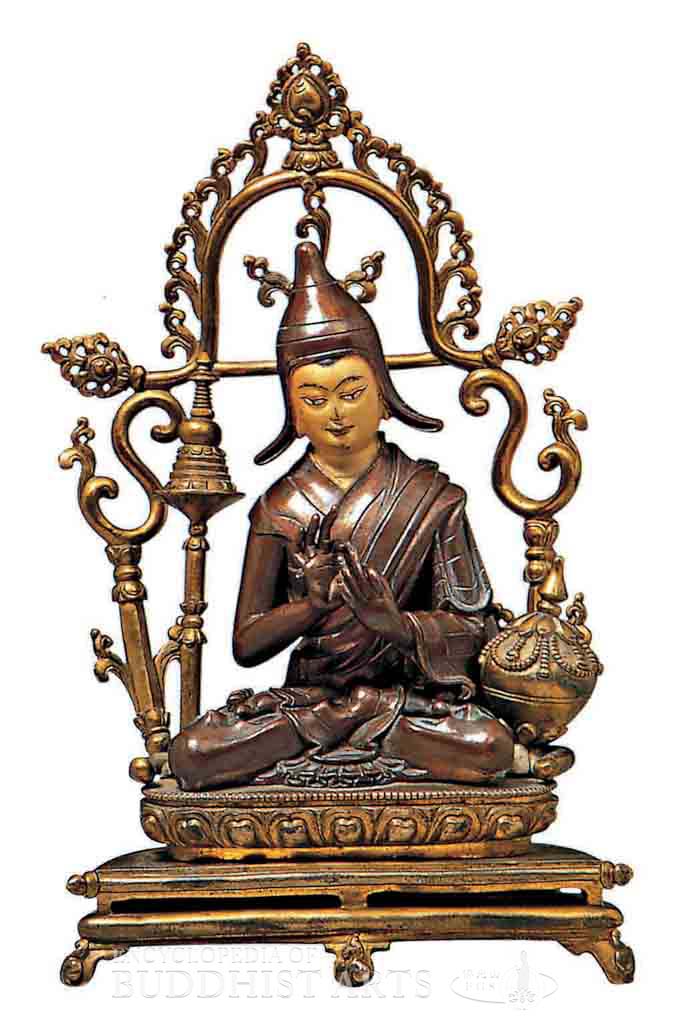
Norbulingka Palace: Atisa
Copper alloy
Norbulingka Palace: Atisa
CHINA, Tibet, Lhasa; Qing dynasty
Atisa is an eminent Indian monk who went to revive Buddhism in Tibet during the 11th century and is acknowledged as the patriarch of the Kadam school. This 17th to 18th century artwork depicts him in monastic robe, wearing the pointed hat of a teacher. The figure sits in full lotus position and leans to one side with hands in Dharmacakra (Dharma wheel) mudra. There are two symbolic items, a spherical container on the right that represents the bell-shaped stupa he introduced from India, and the traditional Tibetan stupa on the left, his identifying symbol. The throne is special as it is similar to Chinese chairs of the Ming dynasty (1368–1644). Encircling the head is a hollow-arched mandorla, outlined with vine-like patterns, that is connected by large S-shaped motifs to the pillars that join the lotus pedestal.
For more details, go to the Encyclopedia of Buddhist Arts: Sculpture N-Sr, page 768.
Cite this article:
author = Hsingyun and Youheng and Lovelock, Yann and Chou, Yuan and Huntington, Susan and Edson, Gary and Neather, Robert,
booktitle = {Encyclopedia of Buddhist Arts: Sculpture N-Sr},
pages = 768,
title = {{Norbulingka Palace: Atisa}},
volume = 12,
year = {2016}}