
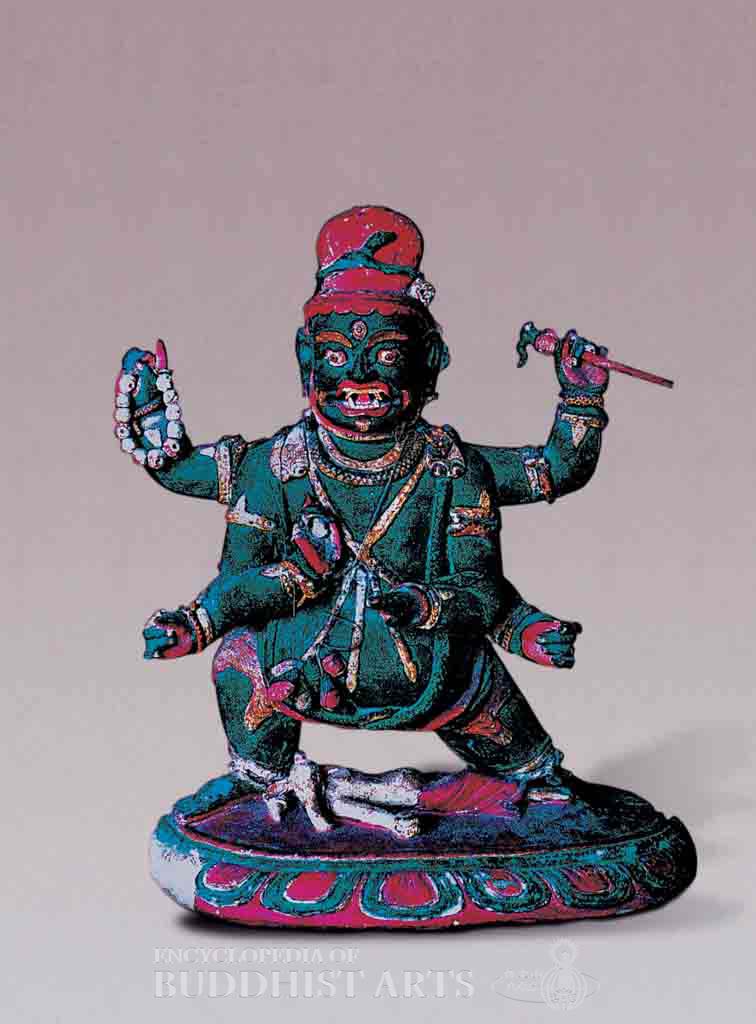
Gaiji Monastery: Six-Armed Mahakala
Clay
Gaiji Monastery: Six-Armed Mahakala
CHINA, Tibet, Lhasa
Mahakalas are usually depicted with three eyes and six arms in Tibetan Buddhism, while the flame-colored hair tied with a snake is a feature that appeared during the 12th to 13th centuries. The protectors are commonly depicted with a robust build and short limbs. The figure has large glaring eyes and a snarling mouth, while holding a cleaver and a skull cup in the two main hands. Both of these objects have been damaged, while the hand-drum and snare are missing from the remaining hands. Only prayer beads made of skulls is held aloft in the right hand while a trident is grasped in the left hand. Jewelry adorns the figure and a piece of tiger skin is wrapped around the waist. Mahakala assumes the warrior stance as he tramples a corpse beneath him on the pedestal.
For more details, go to the Encyclopedia of Buddhist Arts: Sculpture G-M, page 363.
Cite this article:
author = Hsingyun and Youheng and Lovelock, Yann and Chou, Yuan and Huntington, Susan and Edson, Gary and Neather, Robert,
booktitle = {Encyclopedia of Buddhist Arts: Sculpture G-M},
pages = 363,
title = {{Gaiji Monastery: Six-Armed Mahakala}},
volume = 11,
year = {2016}}