
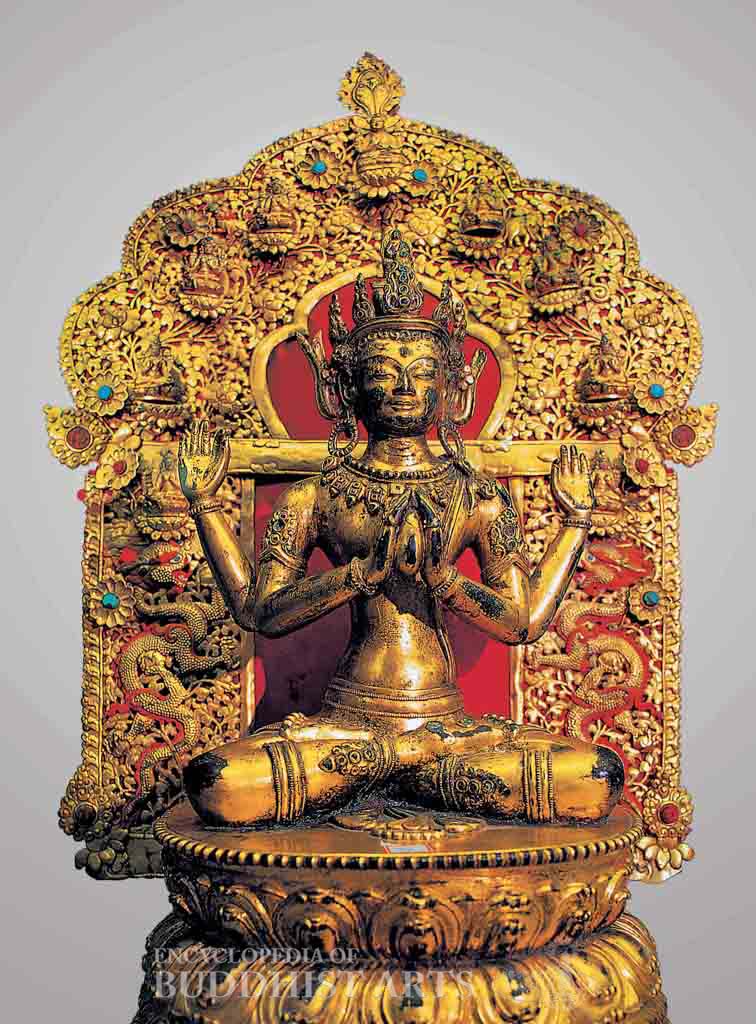
Four-Armed Avalokitesvara
Gilt copper alloy
Four-Armed Avalokitesvara
CHINA; Ming dynasty
The four-armed form of Avalokitesvara usually depicts the Bodhisattva as the Six-Syllable Wisdom King, the embodiment of the Six-Syllable Mantra, “om mani padme hum.” The connection occurs for the first time in the Karandavyuha Sutra, dating from the late 4th century to the early 5th century. The four arms of this manifestation are interpreted as the four illimitable states of the compassionate mind, which include loving kindness, wise compassion, empathy, and non-discrimination. The palms of the two main hands join at heart level in the manidhara (jewel-holding) mudra and hold between them a wish-fulfilling jewel, representing the mind of enlightenment. The other two hands formerly held a lotus and some prayer beads.
The Bodhisattva’s tranquil eyes are half-closed beneath a five-leaf crown decorated with Amitabha’s image at the center. Besides the crown, the figure wears five other jeweled ornaments, symbolizing the six perfections of generosity, morality, patience, endeavor, meditation and wisdom that are cultivated by the Bodhisattva. The slim, broad-shouldered figure sits in full lotus position upon a lotus pedestal.
The figure is backed by a lavish mandorla, enchased with patterns of intertwining branches and gem-studded flowers. Nine Buddha images arch about the seated figure, while two facing dragons writhe below. The style is Chinese, leading to the conjecture that it may be a later addition.
For more details, go to the Encyclopedia of Buddhist Arts: Sculpture A-F, page 349.
Cite this article:
author = Hsingyun and Youheng and Lovelock, Yann and Chou, Yuan and Huntington, Susan and Edson, Gary and Neather, Robert,
booktitle = {Encyclopedia of Buddhist Arts: Sculpture A-F},
pages = 349,
title = {{Four-Armed Avalokitesvara}},
volume = 10,
year = {2016}}