
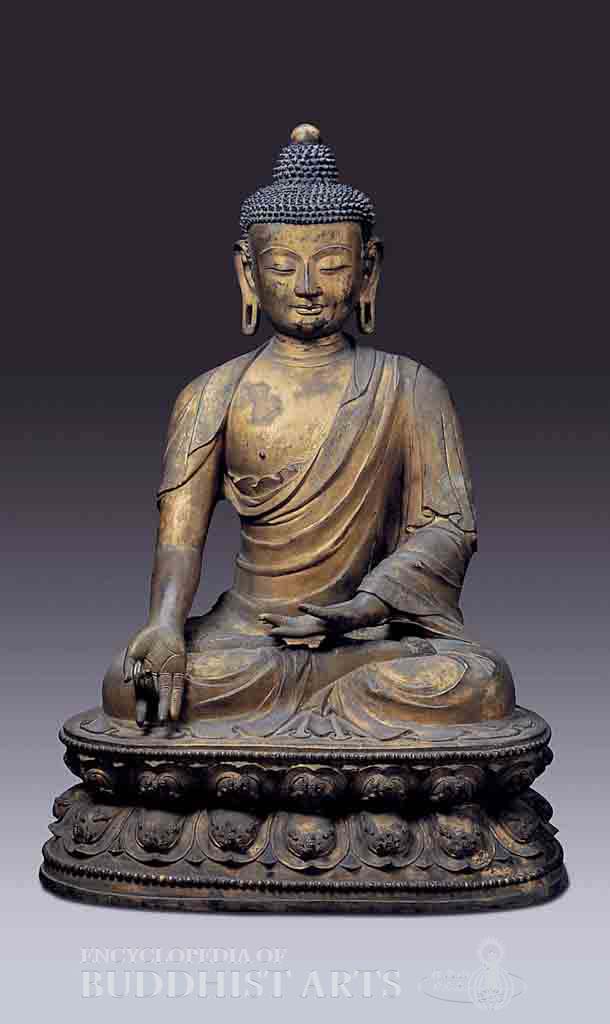
Medicine Buddha
Gilt copper alloy
Medicine Buddha
CHINA; Ming dynasty
The Buddha has various signs of superior spirituality, such as the raised usnisa, elongated ears, and three lines on the neck. The figure sits in half lotus position, wearing a simple monastic robe. The left hand relaxed in the lap originally held a medicine bowl, while the right hand is extended over the knee in lotus mudra and holds a pill. The inscription engraved on the side of the double lotus throne states that the sculpture was completed in 1450, during the Ming dynasty (1368–1644), by the donations of Daoguan, a monk of the Vinaya school and abbot of Longquan Temple (present day Tanzhe Temple) that is located in Beijing.
For more details, go to the Encyclopedia of Buddhist Arts: Sculpture G-M, page 712.
Cite this article:
Hsingyun, et al. "Medicine Buddha." Encyclopedia of Buddhist Arts: Sculpture G-M, vol. 11, 2016, pp. 712.
Hsingyun, Youheng, Yann Lovelock, Yuan Chou, Susan Huntington, Gary Edson, and Robert Neather. 2016. "Medicine Buddha" In Encyclopedia of Buddhist Arts: Sculpture G-M, 11:712.
Hsingyun, Youheng, Lovelock, Y., Chou, Y., Huntington, S., Edson, G., & Neather, R.. (2016). Medicine Buddha. In Encyclopedia of Buddhist Arts: Sculpture G-M (Vol. 11, pp. 712).
@misc{Hsingyun2016,
author = Hsingyun and Youheng and Lovelock, Yann and Chou, Yuan and Huntington, Susan and Edson, Gary and Neather, Robert,
booktitle = {Encyclopedia of Buddhist Arts: Sculpture G-M},
pages = 712,
title = {{Medicine Buddha}},
volume = 11,
year = {2016}}
author = Hsingyun and Youheng and Lovelock, Yann and Chou, Yuan and Huntington, Susan and Edson, Gary and Neather, Robert,
booktitle = {Encyclopedia of Buddhist Arts: Sculpture G-M},
pages = 712,
title = {{Medicine Buddha}},
volume = 11,
year = {2016}}