
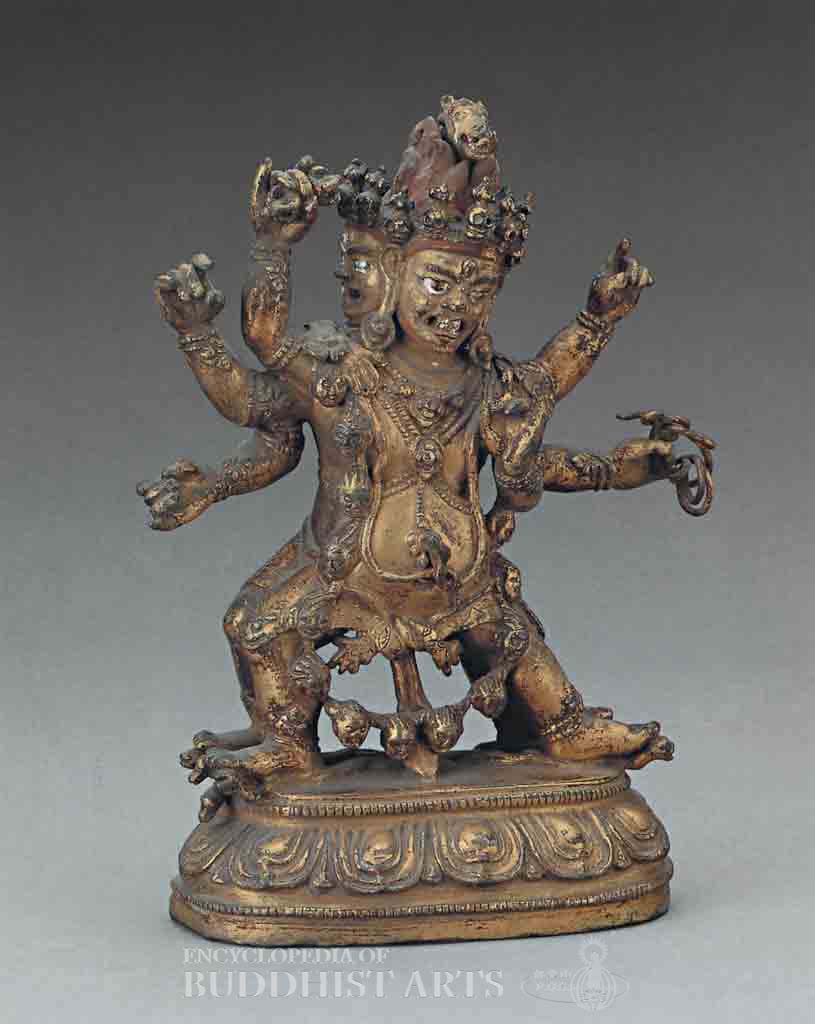
Hayagriva
Copper alloy
Hayagriva
CHINA; Ming dynasty
Hayagriva is a wrathful manifestation of Avalokitesvara that appears in various forms but predominantly in Vajrayana Buddhism. This image has three faces, six arms, and four feet. The three faces have a ferocious visage, each wearing a skull crown surrounding the red hair that stands up like flames, topped with the head of a neighing horse. The body is draped with a garland of skulls and an animal hide is worn around the waist. The six hands once carried different Dharma instruments, most now lost, with only a vajra and rope remaining. One of the hands form the karana (warding off evil) mudra. The figure is in the warrior stance and tramples on seven intertwining snakes. The inverted lotus pedestal is oval in shape. The statue shows influence from the Tibetan style.
For more details, go to the Encyclopedia of Buddhist Arts: Sculpture G-M, page 414.
Cite this article:
author = Hsingyun and Youheng and Lovelock, Yann and Chou, Yuan and Huntington, Susan and Edson, Gary and Neather, Robert,
booktitle = {Encyclopedia of Buddhist Arts: Sculpture G-M},
pages = 414,
title = {{Hayagriva}},
volume = 11,
year = {2016}}