
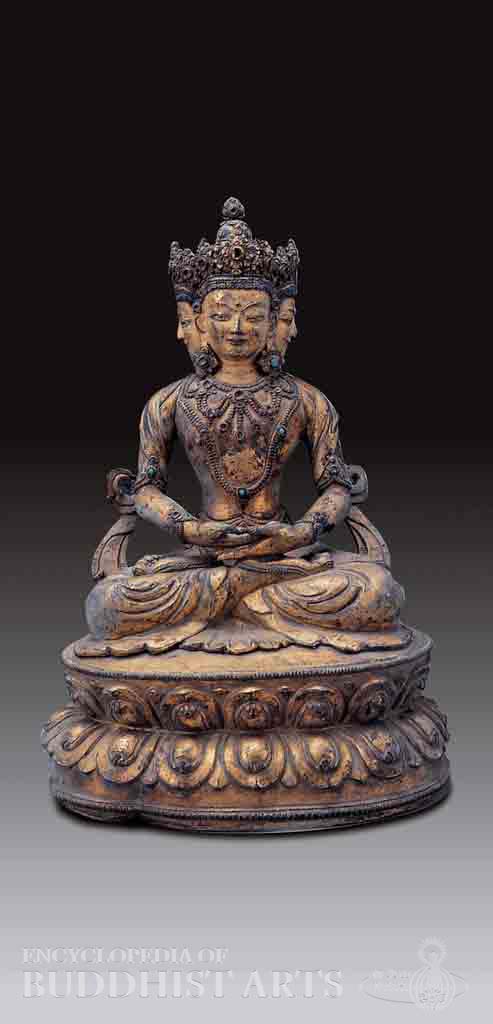
Four-Headed Vairocana
Gilt copper alloy
Four-Headed Vairocana
CHINA; Ming dynasty
This sculpture, with four heads, was a popular figure of offering in western Tibet during earlier times and used for purificatory practices to assure a favorable rebirth. The heads, wearing decorative crowns and earrings studded with turquoises, gaze down with compassion. The bare upper body is ornamented with jewels and draped with a stole that flows over both arms to the skirted under-robe. The Buddha sits in full lotus position with hands in dhyana (meditation) mudra upon a double lotus pedestal. A Tibetan inscription is on the bottom rim of the pedestal.
For more details, go to the Encyclopedia of Buddhist Arts: Sculpture A-F, page 352.
Cite this article:
Hsingyun, et al. "Four-Headed Vairocana." Encyclopedia of Buddhist Arts: Sculpture A-F, vol. 10, 2016, pp. 352.
Hsingyun, Youheng, Yann Lovelock, Yuan Chou, Susan Huntington, Gary Edson, and Robert Neather. 2016. "Four-Headed Vairocana" In Encyclopedia of Buddhist Arts: Sculpture A-F, 10:352.
Hsingyun, Youheng, Lovelock, Y., Chou, Y., Huntington, S., Edson, G., & Neather, R.. (2016). Four-Headed Vairocana. In Encyclopedia of Buddhist Arts: Sculpture A-F (Vol. 10, pp. 352).
@misc{Hsingyun2016,
author = Hsingyun and Youheng and Lovelock, Yann and Chou, Yuan and Huntington, Susan and Edson, Gary and Neather, Robert,
booktitle = {Encyclopedia of Buddhist Arts: Sculpture A-F},
pages = 352,
title = {{Four-Headed Vairocana}},
volume = 10,
year = {2016}}
author = Hsingyun and Youheng and Lovelock, Yann and Chou, Yuan and Huntington, Susan and Edson, Gary and Neather, Robert,
booktitle = {Encyclopedia of Buddhist Arts: Sculpture A-F},
pages = 352,
title = {{Four-Headed Vairocana}},
volume = 10,
year = {2016}}