
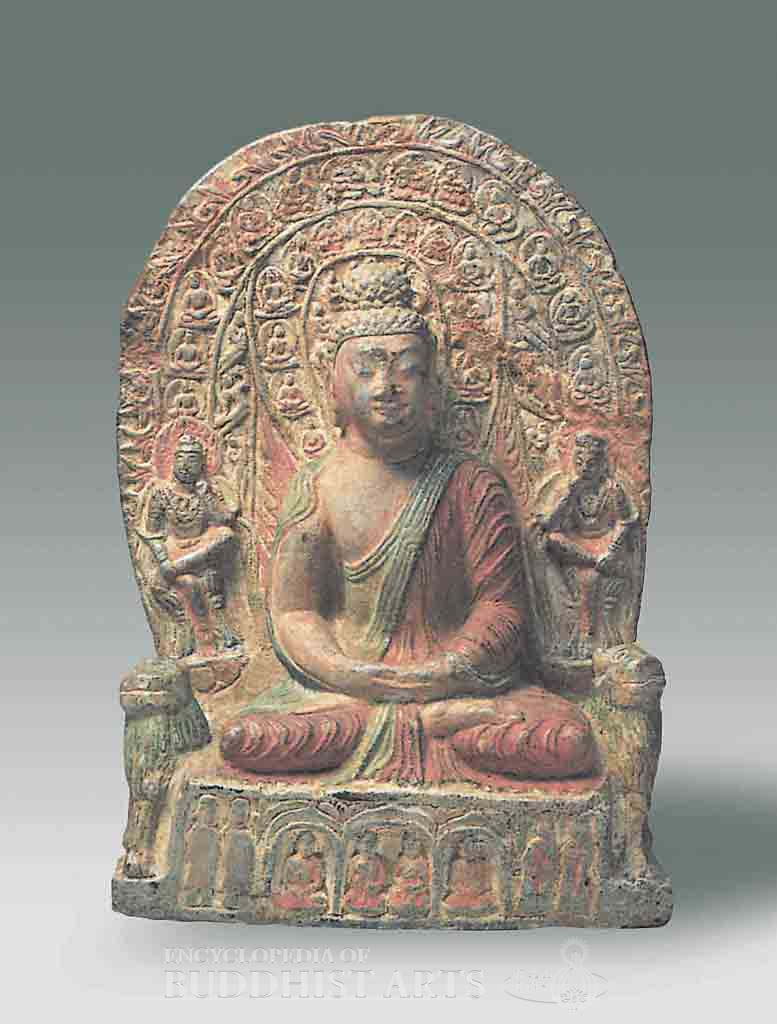
Buddha and Attendants
Stone
Buddha and Attendants
CHINA; Northern Wei dynasty
The Buddha is seated in full lotus position on a throne and forms the dhyana (meditation) mudra with Bodhisattvas on either side. The hair is tightly curled with a prominent usnisa and he wears a red and pale green monastic robe that leaves the right shoulder bare. The Bodhisattvas are seated in the contemplative posture and are adorned with jewelry.
The Buddha’s nimbus and mandorla contain images of Buddhas and apsaras. The outer edge of the mandorla is decorated with a flame motif. Illustrations of the Prince Mahasattva Jataka and the Syama Jataka are on the back of the sculpture.
The front of the throne includes seated Buddhas in niches with standing figures at either end. Two lions are crouching on either side of the throne. An inscription on the sculpture dates it to 455, and identifies Zhang Yong, Zhang Bing, Zhang Bao, Zhang Xing, Zhang Qiu, Zhang Min, and Zhang Chang as the donors.
For more details, go to the Encyclopedia of Buddhist Arts: Sculpture A-F, page 191.
Cite this article:
author = Hsingyun and Youheng and Lovelock, Yann and Chou, Yuan and Huntington, Susan and Edson, Gary and Neather, Robert,
booktitle = {Encyclopedia of Buddhist Arts: Sculpture A-F},
pages = 191,
title = {{Buddha and Attendants}},
volume = 10,
year = {2016}}