
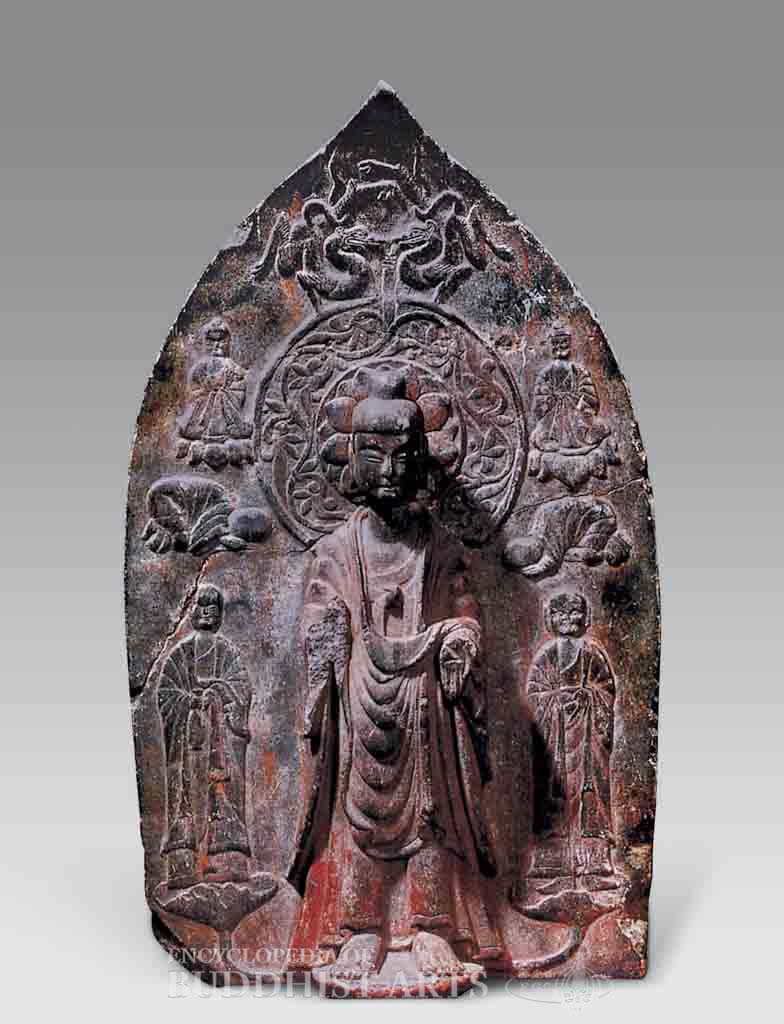
Buddha and Attendants
Limestone
Buddha and Attendants
CHINA; Eastern Wei dynasty
It is believed that the sculpture was excavated from Qufu in Shandong and was acquired by a Japanese archaeologist during the 20th century.
The Buddha stands on a lotus pedestal with one hand in the varada (wish-granting) mudra. The figure wears a monastic robe that is opened at the front and shows a knotted inner robe. Two disciples, in relief, are located on either side. They stand on lotus leaves that are connected to the pedestal. An ornate nimbus consisting of lotus and vine motifs encircles the Buddha’s head. One of the vines extends upwards towards two intertwining dragons at the top. Two seated Buddhas are located on either side of the nimbus, with prostrating figures below them.
An extract from the Diamond Sutra is engraved on the back of the carving along with an inscription that dates the sculpture to 537.
For more details, go to the Encyclopedia of Buddhist Arts: Sculpture A-F, page 195.
Cite this article:
author = Hsingyun and Youheng and Lovelock, Yann and Chou, Yuan and Huntington, Susan and Edson, Gary and Neather, Robert,
booktitle = {Encyclopedia of Buddhist Arts: Sculpture A-F},
pages = 195,
title = {{Buddha and Attendants}},
volume = 10,
year = {2016}}