
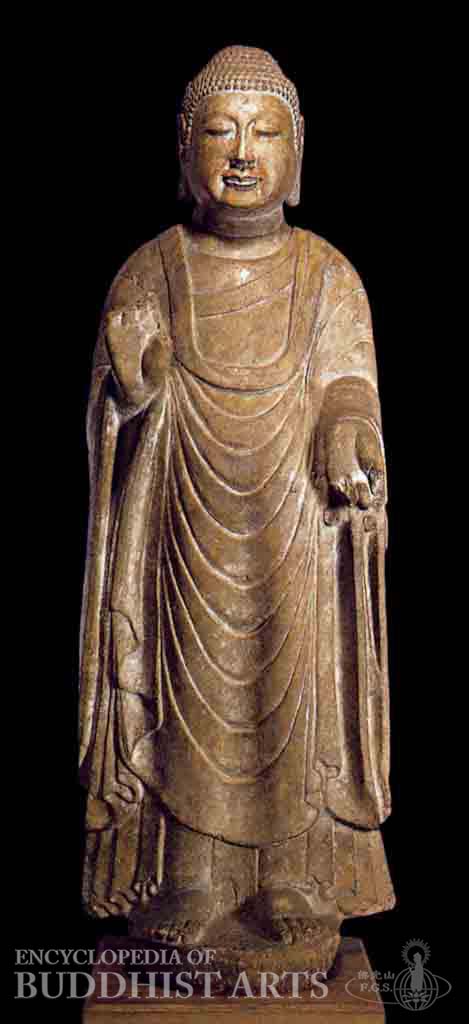
Standing Buddha
Yellow limestone
Standing Buddha
CHINA; Northern Zhou to Sui dynasty
The Buddha’s broad face gives an impression of serenity with its lowered eyes and small relaxed mouth. There is little transition between the hair and the usnisa. Other signs of his status are the elongated earlobes and the three lines on the neck. The damaged right hand is probably raised in abhaya (fearlessness) mudra, and the left hand is cupped in varada (wish-granting) mudra. He wears a monastic robe that covers both shoulders in a way that the collar hangs down and allows one to see an inner robe worn diagonally. The incised folds of the garment lengthen in their fall. The robe spreads in a varied pattern of ripples where the material hangs from the wrists that is repeated in the fall of the under-robe about the feet.
For more details, go to the Encyclopedia of Buddhist Arts: Sculpture St-Z, page 1135.
Cite this article:
author = Hsingyun and Youheng and Lovelock, Yann and Chou, Yuan and Huntington, Susan and Edson, Gary and Neather, Robert,
booktitle = {Encyclopedia of Buddhist Arts: Sculpture St-Z},
pages = 1135,
title = {{Standing Buddha}},
volume = 13,
year = {2016}}