
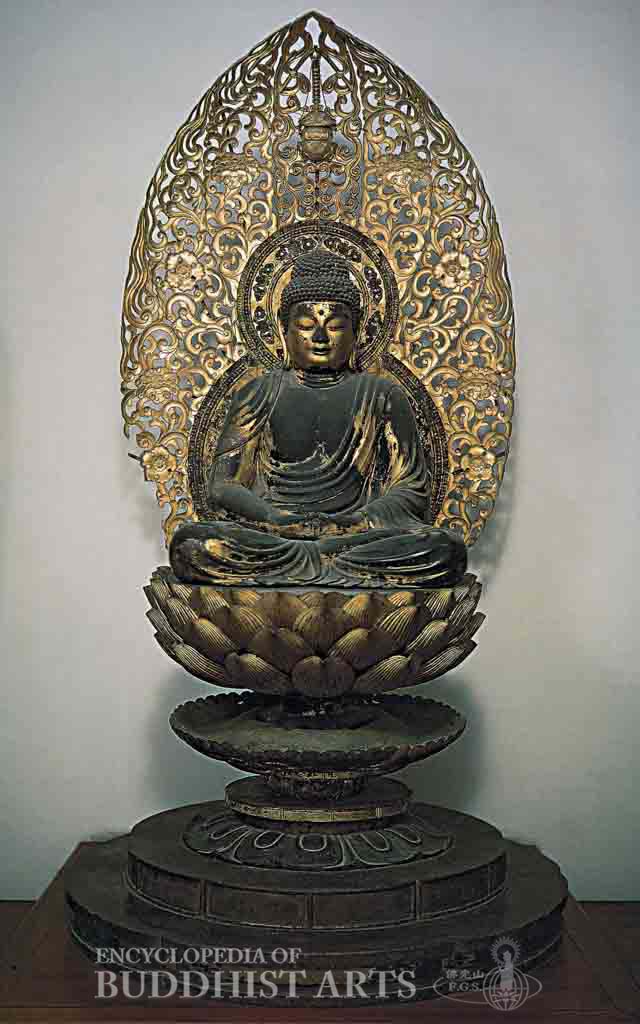
Ninnaji Temple: Amitabha Buddha Triad - Amitabha
Cypress wood
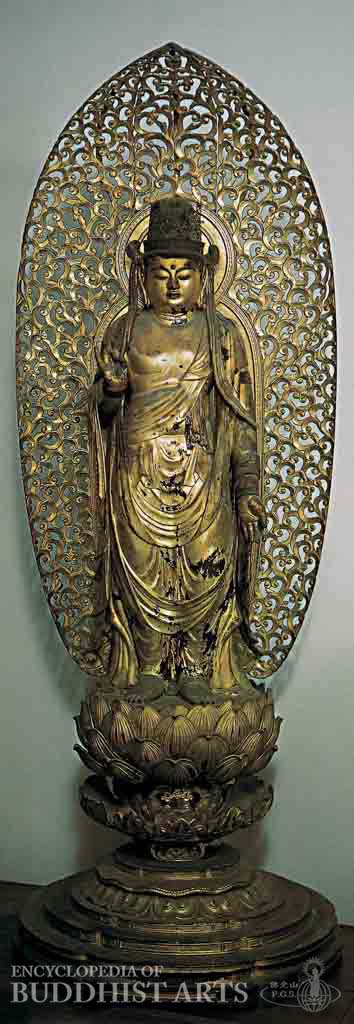
Ninnaji Temple: Amitabha Buddha Triad - Avalokitesvara
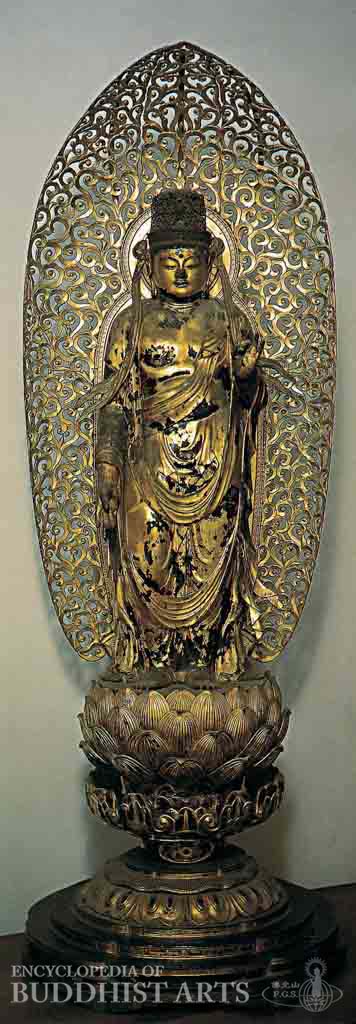
Ninnaji Temple: Amitabha Buddha Triad - Mahasthamaprapta

Ninnaji Temple: Amitabha Buddha Triad
JAPAN, Kyoto; Heian period
The triad was made under imperial order and has been in Ninnaji Temple since 888. This Amitabha Buddha is the earliest to display his characteristic highest grade of the highest class mudra with thumbs and index fingers forming circles. The triad was listed as a National Treasure in 1954.
The torsos of the statues were carved from single blocks of cypress wood, then coated with lacquer and gold foil. A large mandorla is behind each statue with an openwork pattern of curled foliage. Amitabha’s mandorla also incorporates flowers and the image of a pagoda near the crest. The design of the figures, with their rounded faces and sturdy bodies, is typical of the early Heian period (794–1185), when a distinctive Japanese style was beginning to emerge.
Amitabha wears monastic robes and sits in full lotus position on a deep lotus throne resting on a round pedestals. The similar Avalokitesvara and Mahasthamaprapta Bodhisattvas stand barefoot on rather similar lotus pedestals. One of their hands is raised in the lotus mudras while the opposing hands are held in varada (wish-granting) mudras. In the context of the Western Pure Land, the varada mudra may be interpreted as a gesture of greeting.
For more details, go to the Encyclopedia of Buddhist Arts: Sculpture N-Sr, page 763.
Cite this article:
author = Hsingyun and Youheng and Lovelock, Yann and Chou, Yuan and Huntington, Susan and Edson, Gary and Neather, Robert,
booktitle = {Encyclopedia of Buddhist Arts: Sculpture N-Sr},
pages = 763,
title = {{Ninnaji Temple: Amitabha Buddha Triad}},
volume = 12,
year = {2016}}