
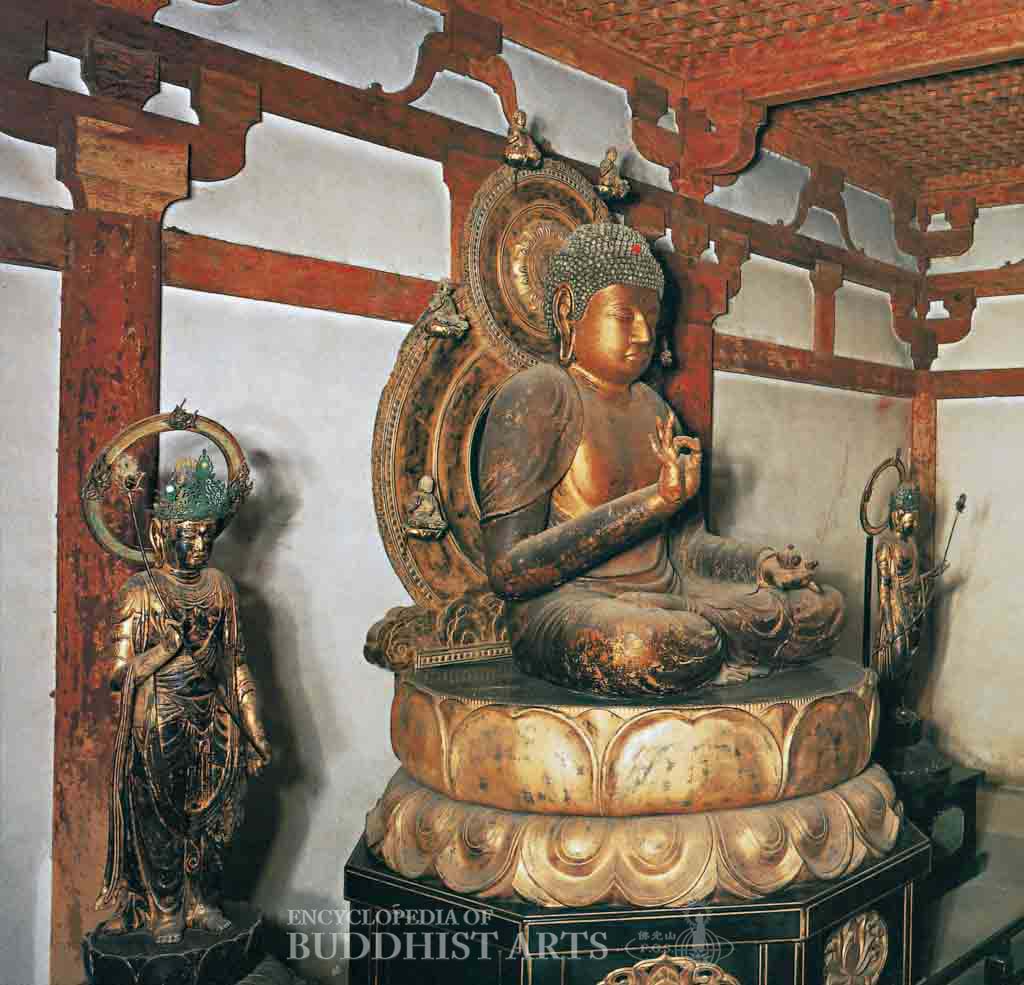
Daigoji Temple Medicine Buddha Hall: Medicine Buddha Triad
Cypress wood
Daigoji Temple Medicine Buddha Hall: Medicine Buddha Triad
JAPAN, Kyoto; Heian period
The construction of these sculptures are thought to have started in 907 under the direction of Master Rigen when the Medicine Buddha Hall was being constructed, and completed in 913 by his disciple. The statues were listed as National Treasures in 1953.
All three statues are sculpted from whole pieces of cypress wood, except for the wrists and knees that were attached separately. The figures were hollowed from behind and the opening enclosed before being coated in black lacquer and gold foil. The large usnisa is overlaid with curls and a jewel was placed just before the protuberance. The jewel and the urna were added later. The aureole and nimbus of the main figure are adorned with six seated Buddhas, signifying the seven healing manifestations of the Medicine Buddha. The figure’s left hand holds a jar of medicine while the right hand forms the vitarka (teaching) mudra. The monastic robe is in the style that dates to the Heian period (710–794).
The flanking attendants, Suryaprabha and Candraprabha, are smaller in size. They are adorned with ringed nimbuses embellished with flames. The figures wear ornate openwork crowns. Their jewelry and garments are sculpted in low relief. Another sculptor may have created the attendant figures since the style is more transitional.
For more details, go to the Encyclopedia of Buddhist Arts: Sculpture A-F, page 277.
Cite this article:
author = Hsingyun and Youheng and Lovelock, Yann and Chou, Yuan and Huntington, Susan and Edson, Gary and Neather, Robert,
booktitle = {Encyclopedia of Buddhist Arts: Sculpture A-F},
pages = 277,
title = {{Daigoji Temple Medicine Buddha Hall: Medicine Buddha Triad}},
volume = 10,
year = {2016}}