
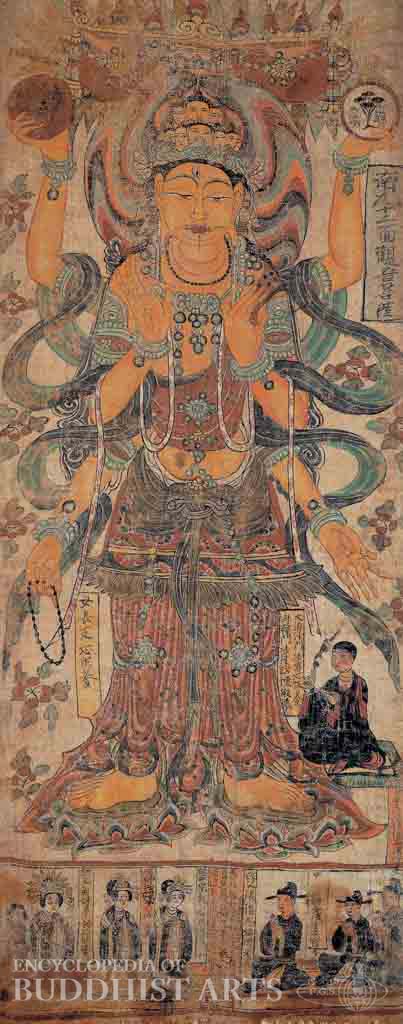
Mogao Cave 17: Twelve-Headed, Six-Armed Avalokitesvara
Ink and color on linen

Mogao Cave 17: Twelve-Headed, Six-Armed Avalokitesvara (detail)
Mogao Cave 17: Twelve-Headed, Six-Armed Avalokitesvara
CHINA, Gansu, Dunhuang; Later Zhou dynasty
Although this image of Avalokitesvara has only eleven heads, an inscription in the upper right corner identifies the figure as Twelve-Headed Avalokitesvara. In the Chronicle of the Buddha and Patriarchs, it is said that Emperor Wu (reigned 502–549) instructed painter Zhang Sengyao to make a portrayal of monk Baozhi. As Baozhi’s facial expressions kept changing over time, Zhang requested Baozhi to remain still. When he did so, an image of the Twelve-Headed Avalokitesvara was revealed.
According to the inscription, this work was completed in 959. The eleven heads are surrounded by a colorful nimbus. The central face has three eyes and is flanked by two heads, one appearing kind and the other with a wrathful look. The other eight heads are arranged in two tiers: five in the lower, and three in the upper tier. The body is covered with jewelry, and ornaments, stoles, and a dhoti. Two raised hands support a sun disc and a moon disc, two hands form mudras in front of the chest, and the lowered right hand holds prayer beads. The Bodhisattva stands on twin lotus pedestals. On the right beside the central figure, a kneeling monk holding an incense burner is identified by an inscription as the patron’s uncle, the monk Fayuan. An inscription on the opposite side states the name of a female, Changzhi.
In the center of the lower register, there is a long inscription by the patron offering this painting to the Eight Classes of Dharma Protectors in prayer for peace in the country and prosperity for society. He also states that he hopes to remain prosperous and happy as a Buddhist. On both sides of the cartouche, the patron Zhang Baozhi and his family are depicted.
For more details, go to the Encyclopedia of Buddhist Arts: Painting I-O, page 678.
Cite this article:
author = Hsingyun and Youheng and Youlu and Wilson, Graham and Manho and Mankuang and Huntington, Susan,
booktitle = {Encyclopedia of Buddhist Arts: Painting I-O},
pages = 678,
title = {{Mogao Cave 17: Twelve-Headed, Six-Armed Avalokitesvara}},
volume = 15,
year = {2016}}