
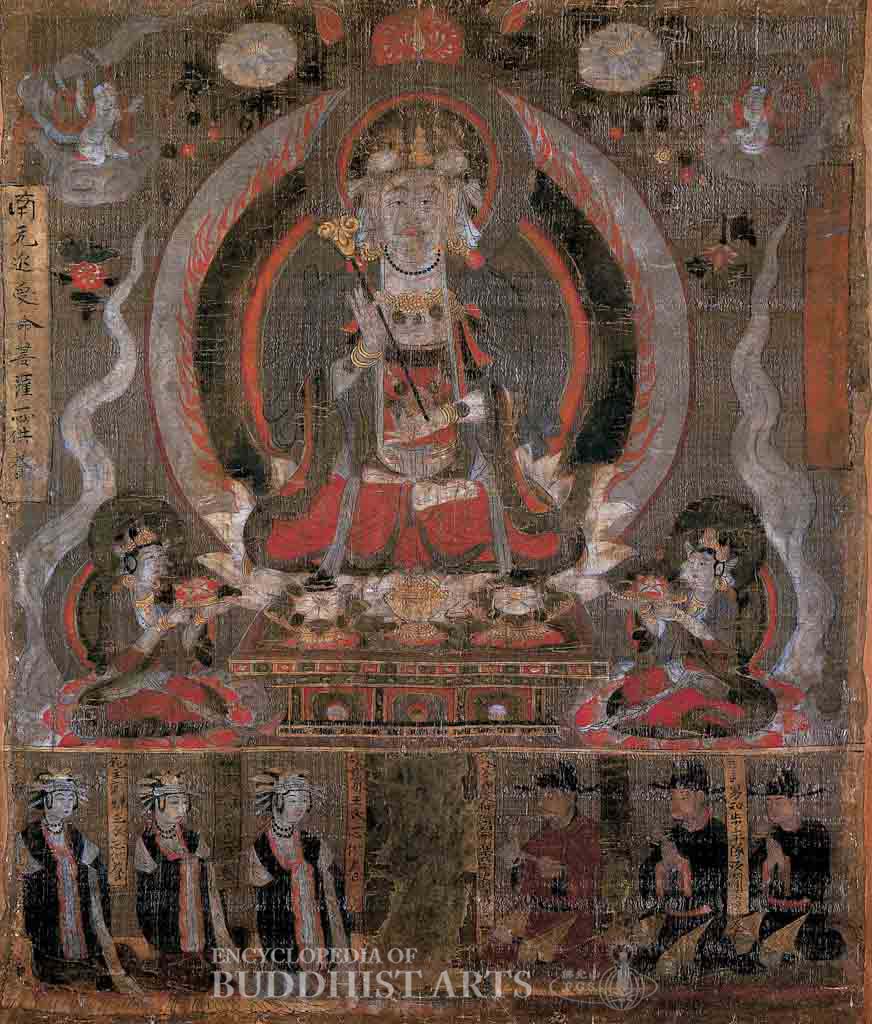
Mogao Cave 17: Longevity Bodhisattva
Ink and color on silk
Mogao Cave 17: Longevity Bodhisattva
CHINA, Gansu, Dunhuang; Northern Song dynasty
An inscription on the left side of this painting states that it depicts Longevity Bodhisattva. The Bodhisattva wears a headdress and ornaments, all colored in gold. Sitting on a white lotus throne, the Bodhisattva holds a ruyi (wish-fulfilling talisman) decorated with a golden floral ornament in both hands. The nimbus and aureole are embellished with flames and encircled by a white mandorla. The Bodhisattva is sheltered under three floriated canopies flanked by children riding on clouds. A golden incense burner and dishes covered with flowers are set on the altar below the central figure. Two Bodhisattvas seated upon red lotuses descend from the sky to make flower offerings on both sides of the altar.
The inscription in the center of the lower register separates groups of male and female devotees. The female devotees on the left are identified by inscriptions as the deceased mother and the wives of the patron. The three male devotees, wearing black hats and official’s robes, are the patron’s deceased father, the patron himself, and his son. The name of the patron is indecipherable. The headdresses worn by the female figures suggest that this painting dates from late 10th century.
For more details, go to the Encyclopedia of Buddhist Arts: Painting I-O, page 629.
Cite this article:
author = Hsingyun and Youheng and Youlu and Wilson, Graham and Manho and Mankuang and Huntington, Susan,
booktitle = {Encyclopedia of Buddhist Arts: Painting I-O},
pages = 629,
title = {{Mogao Cave 17: Longevity Bodhisattva}},
volume = 15,
year = {2016}}