
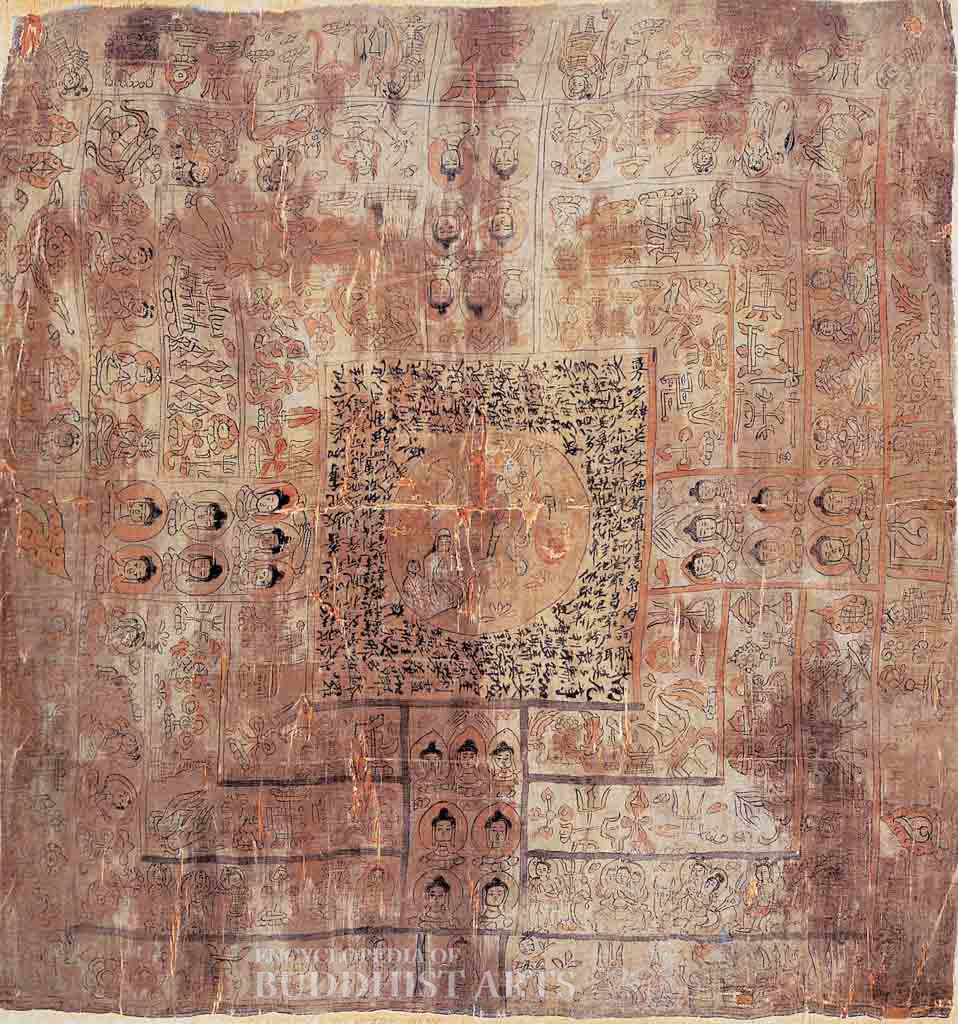
Mogao Cave 17: Mandala
Ink and color on silk
Mogao Cave 17: Mandala
CHINA, Gansu, Dunhuang; Tang dynasty to Five Dynasties
This mandala, painted on a glossy piece of silk, dates from late 9th to early 10th century. In the central circle, a woman and a child kneel beneath a rising trail of smoke. Beside them is a Wisdom King holding a vajra, with the right foot on a lotus throne and the left foot raised.
The square frame around the circle is inscribed with the dharani from the Usnisavijaya Dharani Sutra, moving inwards in a clockwise direction. This dharani describes the merits of Usnisavijaya in 87 verses. A Chinese character representing the Sanskrit syllable “om” is written four times just outside the circle, lining up with the four corners of the square. The inner square is contained within four larger squares covered with images. Each of the four gates of the mandala is filled in with seven Buddha heads and a pair of hands forming a mudra. In the top left corner of the third outer square, Hariti can be seen, surrounded by her children.
For more details, go to the Encyclopedia of Buddhist Arts: Painting I-O, page 633.
Cite this article:
author = Hsingyun and Youheng and Youlu and Wilson, Graham and Manho and Mankuang and Huntington, Susan,
booktitle = {Encyclopedia of Buddhist Arts: Painting I-O},
pages = 633,
title = {{Mogao Cave 17: Mandala}},
volume = 15,
year = {2016}}