
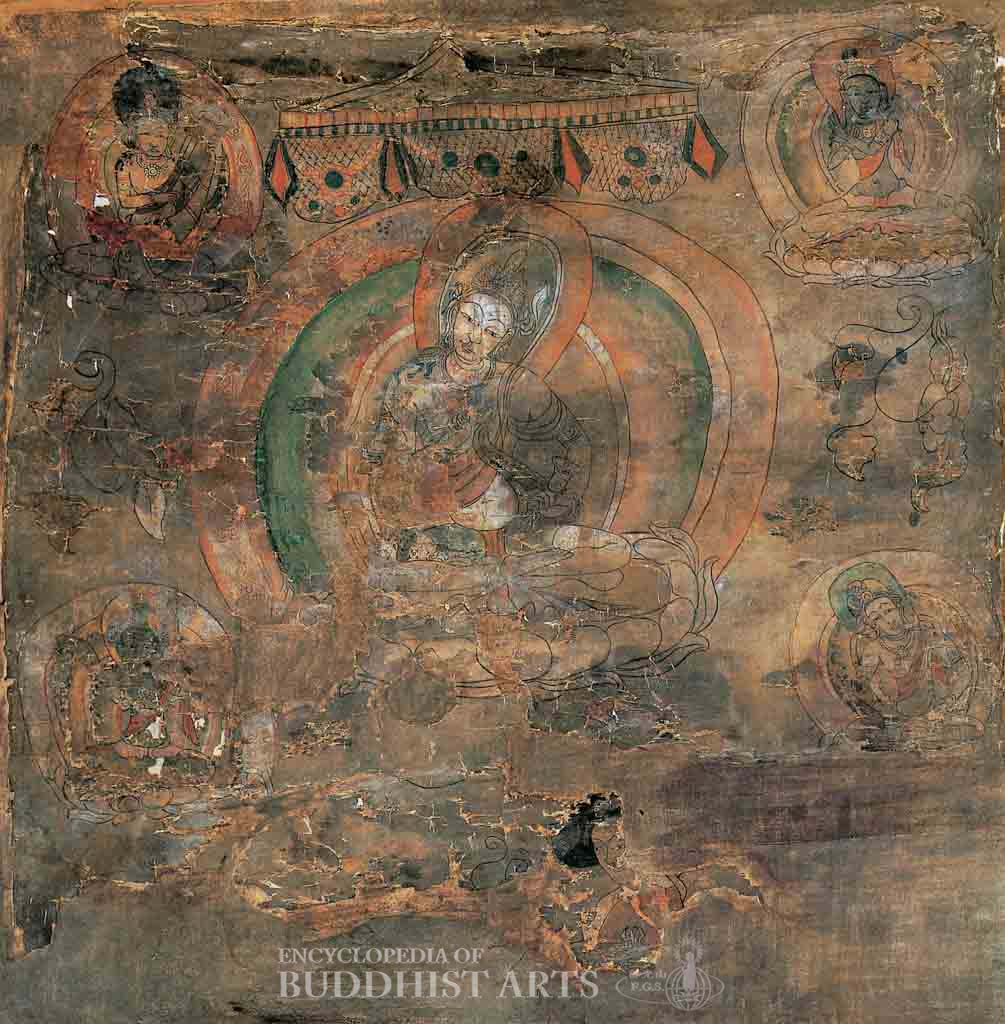
Mogao Cave 17: Vajrasattva Mandala
Ink and color on silk
Mogao Cave 17: Vajrasattva Mandala
CHINA, Gansu, Dunhuang; Tang dynasty
Vajrasattva Bodhisattva is known for his vow to overcome all negative karmas. In this mandala found in Mogao Cave 17, the white-bodied Vajrasattva sits in full lotus position on a lotus throne, tilting the head to one side. The Bodhisattva wears a headdress and is sheltered by a canopy. A petal-shaped nimbus and a quickly painted aureole surround the figure. The right hand holds a vajra and the left hand holds a bell facing upwards. The description of Vajrasattva in the Adhyardhasatika Prajnaparamita states that the bell should face downward; although in most images of Vajrasattva found in Tibet and Nepal, the bell tends to face upward.
There is a Bodhisattva in each of the four corners. Vajragiti and Vajramala are in the upper corners; Vajranrti and Vajralasi occupy the lower corners. The damaged female figure partially visible in the center of the lower register is thought to be the donor of the painting.
For more details, go to the Encyclopedia of Buddhist Arts: Painting I-O, page 684.
Cite this article:
author = Hsingyun and Youheng and Youlu and Wilson, Graham and Manho and Mankuang and Huntington, Susan,
booktitle = {Encyclopedia of Buddhist Arts: Painting I-O},
pages = 684,
title = {{Mogao Cave 17: Vajrasattva Mandala}},
volume = 15,
year = {2016}}