
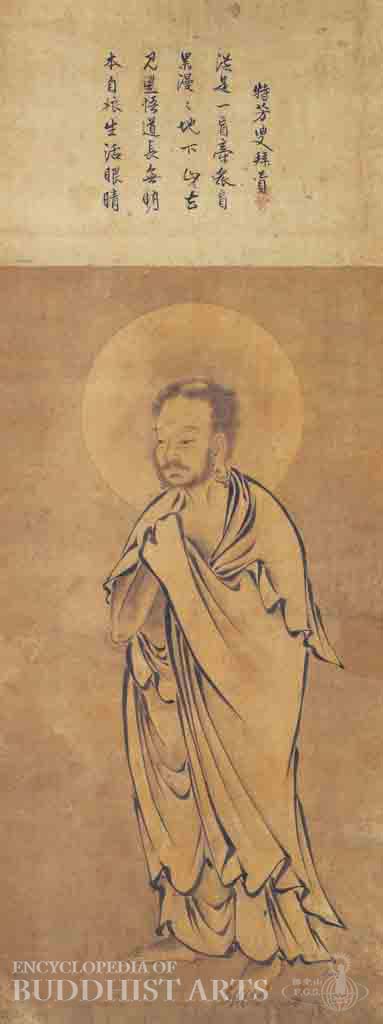
Ascetic Sakyamuni; Muromachi period
Ink on paper
Kano Motonobu
JAPAN; Muromachi period
The son of Kano Masanobu, the founding master of the Kano school, Kano Motonobu was a painter and member of a family of imperial painters during the Muromachi period. Born with the name Shirojiro, he was also known as Oinosuke or Echizen no Kami; he was also honored the rank of Hogen (Dharma Eye) and is posthumously regarded as Kohogen. Motonobu inherited his father’s painting style and incorporated the technique of yamato-e to create the principle style of the Kano school. He was regarded alongside Kano Eitoku and Kano Tanyu as one of the Three Painting Masters of the Kano school.
Among his paintings on sliding screen murals and fans, he created several portraits of Chan masters and patriarchs of the Pure Land school of Buddhism. The earliest record of a painting by Motonobu was in 1513 when he was commissioned by Samurai Hosokawa Takakuni to create the Origin of Kuramadera Temple. In the same year, together with Soami and his disciples, he painted the sliding screen murals of the guest hall of Daisenin Temple in Kyoto.
Several of his paintings have been listed as Important Cultural Properties of Japan, including the vibrantly colored eight-piece folding screen of Birds and Flowers of the Four Seasons, kept at Daisenin Temple, and six paintings of Chan Patriarchs, collected at the Tokyo National Museum.
Other masterpieces which were listed as Important Cultural Properties of Japan include Eight Views of Hunan and the screen mural in the Abbot Room of Myoshinji Temple in Kyoto; Knocking Over the Vase, collected at Ryoanji Temple in Kyoto; and Origin of Seiryoji Temple, in the Sakyamuni Hall of Seiryoji Temple in Kyoto. In addition, Kano painted Ascetic Sakyamuni and Parinirvana, collected at Ryotanji Temple in Kyoto and Seiryoji Temple, respectively.
For more details, go to the Encyclopedia of Buddhist Arts: People, page 131.
Cite this article:
author = Hsingyun and Youheng and Youlu and Pokorski, Stefanie and Yichao and Mankuang and Miaohsi,
booktitle = {Encyclopedia of Buddhist Arts: People },
pages = 131,
title = {{Kano Motonobu}},
volume = 19,
year = {2016}}