
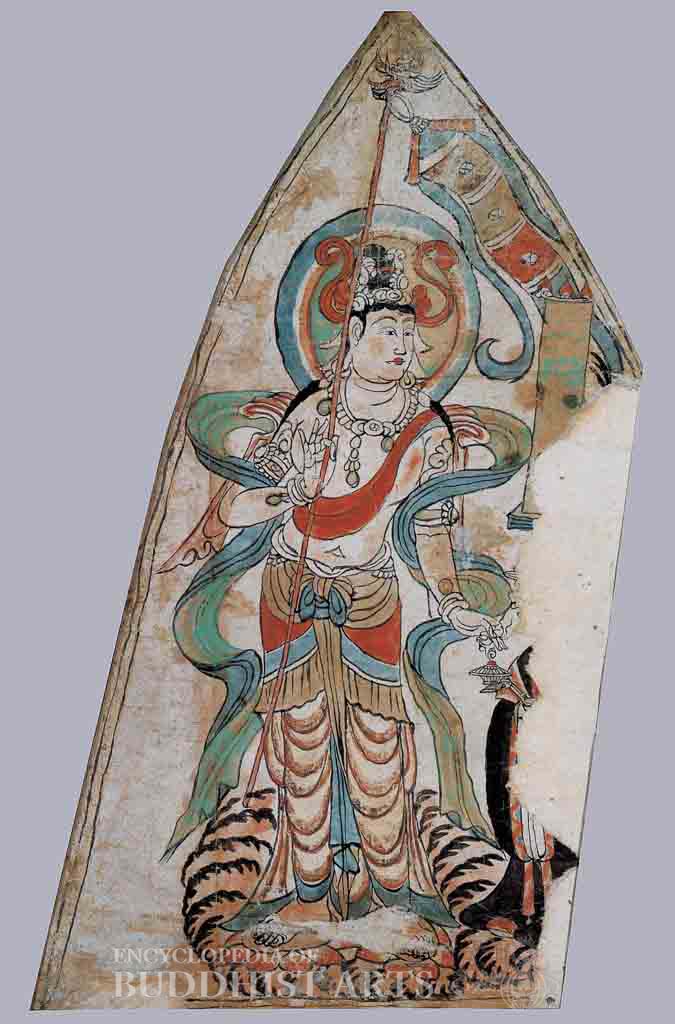
Mogao Cave 17: Bodhisattva as a Guide
Ink and color on paper
Mogao Cave 17: Bodhisattva as a Guide
CHINA, Gansu, Dunhuang; Five Dynasties
Based on the painting technique, this work is thought to have been made during the second half of the 10th century. Ogival in shape, it is composed of four layers of heavy paper glued together. The Bodhisattva has a round face, red lips, and a thick neck. A headdress with raised red ribbons attached to the sides partially covers the high topknot. The nimbus is composed of colored rings. Ornaments adorn the body. The feet rest on two lotus pedestals. The right hand holds a banner pole with a dragon head at the top; the left hand reaches out to a partially visible figure in a guiding gesture. The stole encircling the Bodhisattva’s arms and the long banner appear to float in the wind. Only a hand-held incense burner and part of the deceased’s clothing can be seen. The painting has received much attention due to the uniquely shaped paper.
For more details, go to the Encyclopedia of Buddhist Arts: Painting I-O, page 569.
Cite this article:
author = Hsingyun and Youheng and Youlu and Wilson, Graham and Manho and Mankuang and Huntington, Susan,
booktitle = {Encyclopedia of Buddhist Arts: Painting I-O},
pages = 569,
title = {{Mogao Cave 17: Bodhisattva as a Guide}},
volume = 15,
year = {2016}}