
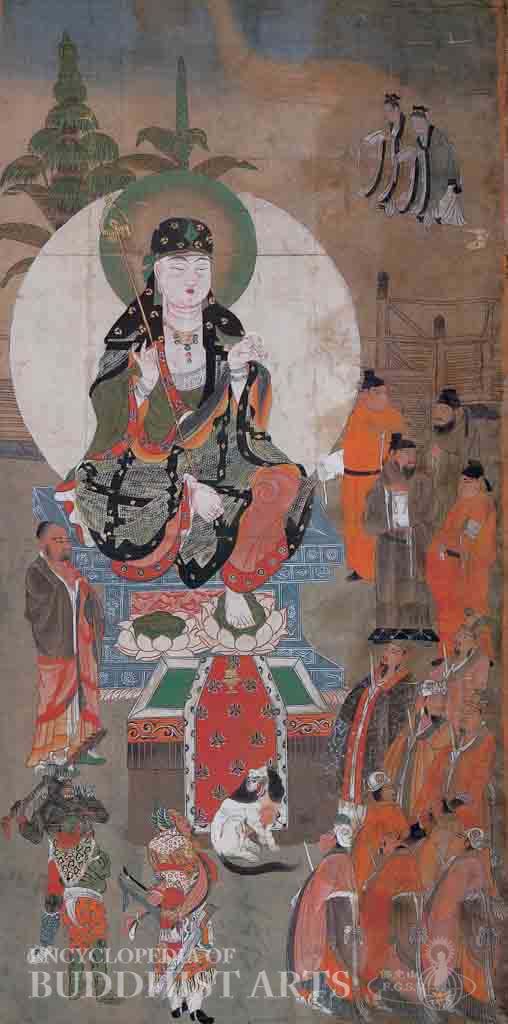
Mogao Cave 17: Ksitigarbha Bodhisattva and the Ten Kings of Hell
Ink and color on silk
Mogao Cave 17: Ksitigarbha Bodhisattva and the Ten Kings of Hell
CHINA, Gansu, Dunhuang; Northern Song dynasty
This painting from the latter half of the 10th century was discovered in Mogao Cave 17 and portrays Ksitigarbha Bodhisattva with a green nimbus and a large white mandorla. The Bodhisattva sits in a variation of relaxation posture upon a diamond throne, resting the left foot on a lotus pedestal. Both the black headscarf and the patched monastic robe are adorned with gold patterns. The left hand cradles a wish-fulfilling jewel and the right hand grasps a monk’s staff.
A lion crouches before the altar below Ksitigarbha, while the monk Daoming stands on the left with clasped hands. To the right of Ksitigarbha, there are four judges wearing black hats, three of whom hold scrolls in their hands. Nine of the Ten Kings of Hell are portrayed on the lower right, holding scepters and wearing ceremonial robes and hats. The fifth king, King Zhuanlun, dressed in armor, is painted beside two fierce raksasas on the left side of the lower register. In the upper right corner, the Recorders of Good and Evil stand on clouds. The banana trees and balustrade in the background add depth to the painting. Creatively arranged figures, refreshing hues, and fine details make this artwork stand out from the other Dunhuang paintings.
For more details, go to the Encyclopedia of Buddhist Arts: Painting I-O, page 620.
Cite this article:
author = Hsingyun and Youheng and Youlu and Wilson, Graham and Manho and Mankuang and Huntington, Susan,
booktitle = {Encyclopedia of Buddhist Arts: Painting I-O},
pages = 620,
title = {{Mogao Cave 17: Ksitigarbha Bodhisattva and the Ten Kings of Hell}},
volume = 15,
year = {2016}}