
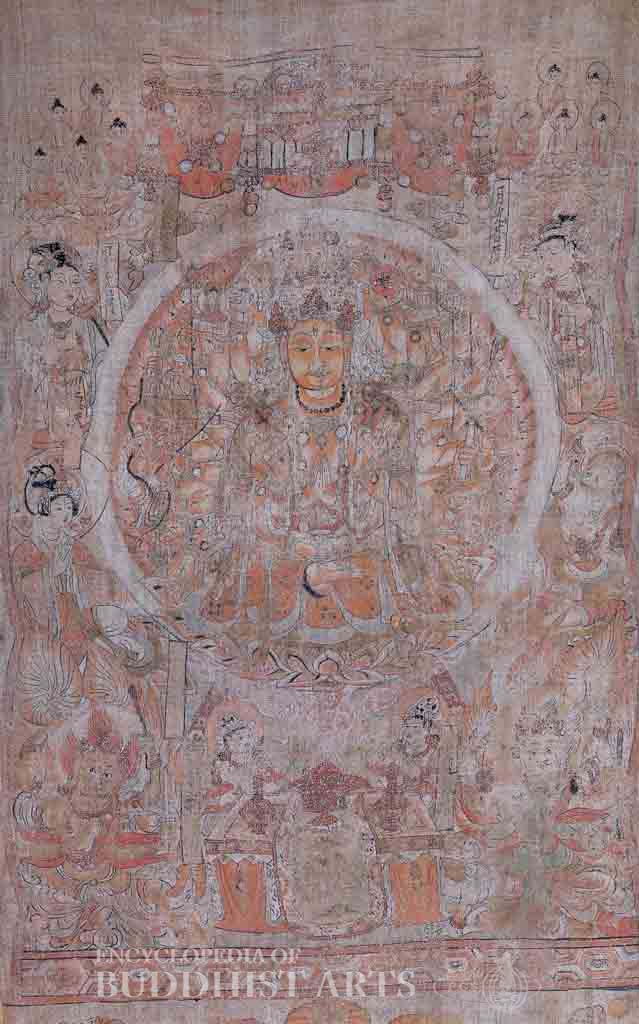
Mogao Cave 17: Avalokitesvara, Ksitigarbha and the Ten Kings of Hell - Avalokitesvara (top register)
Ink and color on linen
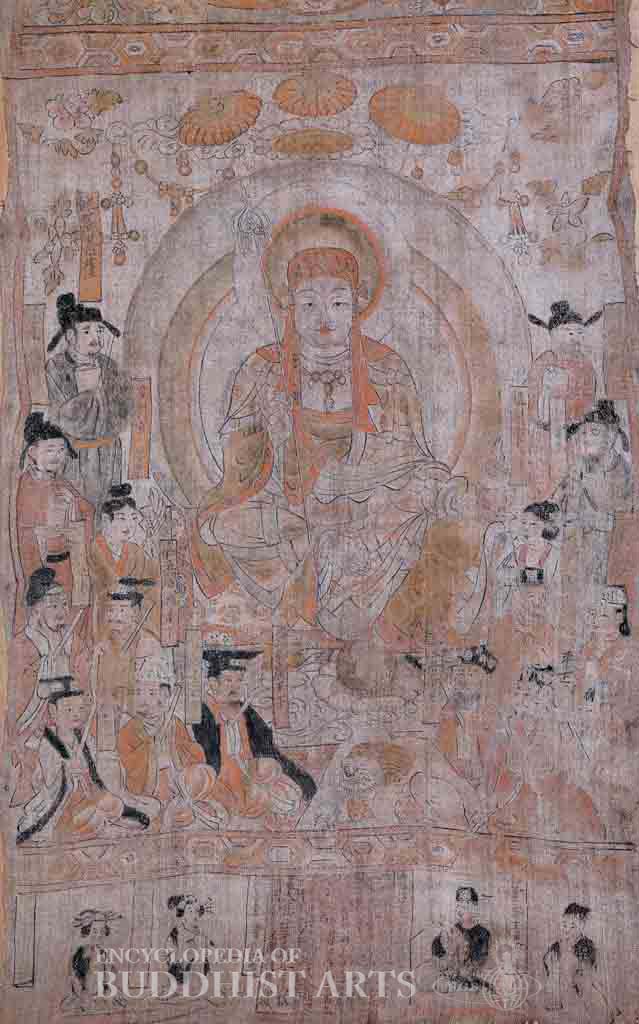
Mogao Cave 17: Avalokitesvara, Ksitigarbha and the Ten Kings of Hell - Ksitigarbha and Donors (middle and lower registers)
Mogao Cave 17: Avalokitesvara, Ksitigarbha, and the Ten Kings of Hell
CHINA, Gansu, Dunhuang; Northern Song dynasty
This painting is divided into three distinct registers with two bands of tortoiseshell patterning. Eleven-headed, Thousand-Armed Avalokitesvara Bodhisattva is painted at the top, Ksitigarbha Bodhisattva and the Ten Kings of Hell are in the middle, and donors are depicted in the lower register.
Avalokitesvara sits in full lotus position on a lotus throne beneath a canopy. The Bodhisattva wears a trefoil crown and ornaments. Ten of the heads are small; barely visible above the crown. The central face has a third eye in the middle of the forehead. The thousand arms, the hands of which hold objects or form mudras, fill the circular mandorla. The Five Dhyani Buddhas sit upon clouds in both upper corners of the picture. Suryaprabha Bodhisattva, Candraprabha Bodhisattva, Mahadevi, and Vasu are located beside Avalokitesvara. At the bottom of the picture, two naga kings appearing as Bodhisattvas stand behind an altar with joined palms. Two Wisdom Kings with standing hair occupy the lower corners.
Ksitigarbha wears a headscarf and sits on a lotus throne. A thin monk’s staff is held in the fingers of the right hand. The colors of the nimbus and the aureole match those of the monastic robe. A canopy decorated with flowers and hanging ornaments can be seen at the top of the picture. The Ten Kings of Hell and their attendants surround Ksitigarbha. All the kings hold an imperial court baton and each is identified by an inscription within a cartouche.
For more details, go to the Encyclopedia of Buddhist Arts: Painting I-O, page 566.
Cite this article:
author = Hsingyun and Youheng and Youlu and Wilson, Graham and Manho and Mankuang and Huntington, Susan,
booktitle = {Encyclopedia of Buddhist Arts: Painting I-O},
pages = 566,
title = {{Mogao Cave 17: Avalokitesvara, Ksitigarbha, and the Ten Kings of Hell}},
volume = 15,
year = {2016}}