
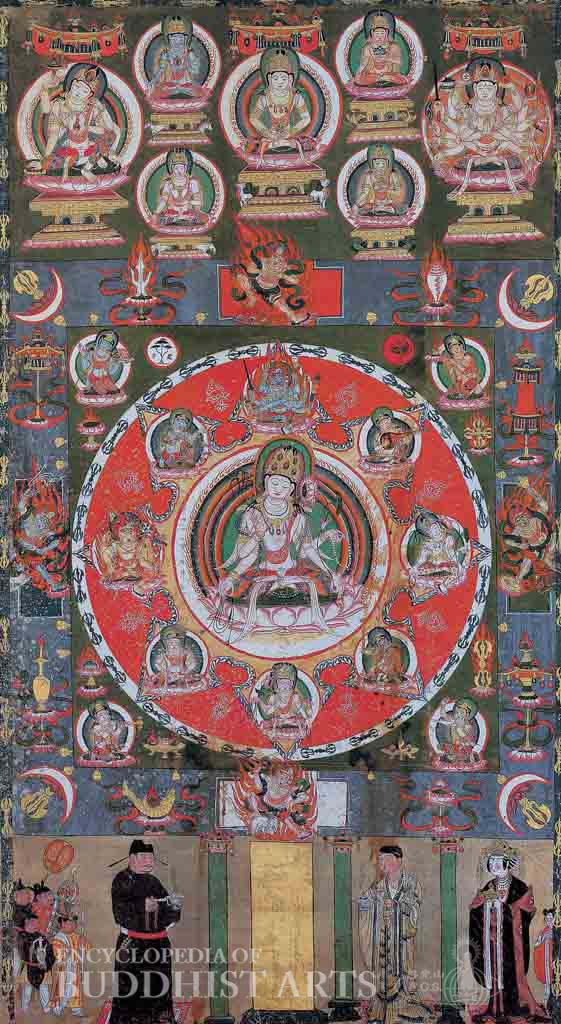
Mogao Cave 17: Amoghapasa Avalokitesvara Mandala
Ink and color on silk
Mogao Cave 17: Amoghapasa Avalokitesvara Mandala
CHINA, Gansu, Dunhuang; Five Dynasties to Northern Song dynasty
This painting dates from the 10th century and is divided into three distinct registers, the upper two of which are devoted to the Diamond Realm. At the top, the Five Dhyani Buddhas, arranged with the larger Vairocana Buddha in the center, are flanked by Thousand-Armed Avalokitesvara on the right and Cintamanicakra Avalokitesvara on the left. All of the figures have colorful nimbuses and mandorlas, wear golden crowns, and are adorned with ornaments.
In the middle register, Amoghapasa Avalokitesvara is portrayed in the center with four hands that hold a willow branch, a lotus, a rope, and beads. Seated in full lotus position on a lotus throne, Amoghapasa is surrounded by a multi-layered, flame-patterned mandorla and a distinctive arrow point pattern. Eight figures occupy the points of the arrows: Ekajata Raksasa, Amoghapasa Avalokitesvara, Hayagriva, Bhrkuti, Vajramala, Vajralasi, Vajranrti, and Vajragiti. The white border of the inner circle is decorated with vajras. In the corners of the brown inner square, there are images of the Four All-embracing Bodhisattvas: Vajrapuspa, Vajradhnpa, Vajragandha, and Vajraloka. The red gates in the middle of the four sides of the blue outer square are guarded by Vajrasphota, Vajrapasa, Vajrankusa, and Vajravesa. These fierce figures stand in dynamic poses and are surrounded by flames. The eight auspicious symbols are painted between the four gates.
Figures making offerings flank an empty cartouche in the lower register. On the left, a male donor wearing a black robe carries an incense burner. Four small attendants stand behind him holding a fan, a teapot, a staff, and a quiver. A nun and a female donor accompanied by an attendant appear on the right. The black border of the painting is decorated with gold vajra patterns.
For more details, go to the Encyclopedia of Buddhist Arts: Painting I-O, page 539.
Cite this article:
author = Hsingyun and Youheng and Youlu and Wilson, Graham and Manho and Mankuang and Huntington, Susan,
booktitle = {Encyclopedia of Buddhist Arts: Painting I-O},
pages = 539,
title = {{Mogao Cave 17: Amoghapasa Avalokitesvara Mandala}},
volume = 15,
year = {2016}}