
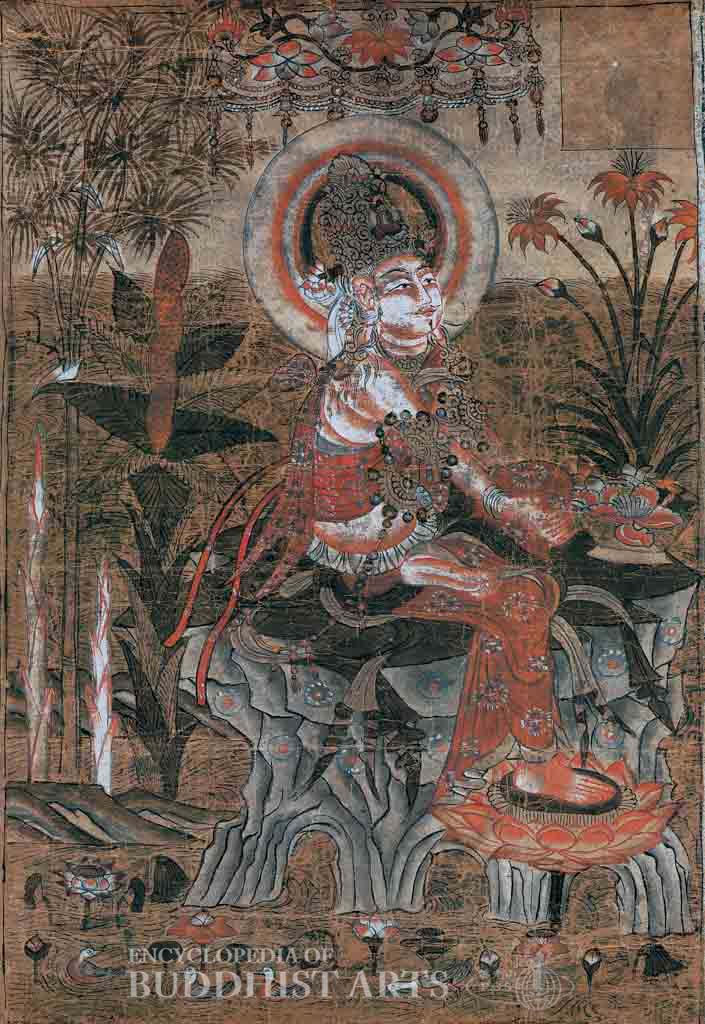
Mogao Cave 17: Water-Moon Avalokitesvara
Ink and color on paper
Mogao Cave 17: Water-Moon Avalokitesvara
CHINA, Gansu, Dunhuang; Tang dynasty to Five Dynasties
Avalokitesvara in “Water-Moon” form is traditionally depicted sitting on a rock above the sea, backed by a large moon-like mandorla. A vase containing a willow branch is often painted nearby. The first image of Water-Moon Avalokitesvara was painted by Zhou Fang during the Tang dynasty (618–907). This painting from late 9th to early 10th century is different from the conventional image: the large mandorla is absent and the arms are clasped around one knee. Avalokitesvara wears a tall headdress with a Buddha image. Thick gold ornaments and a red dhoti cover the body. Seated on a rock, Avalokitesvara lifts the head slightly and gazes upwards. Tall plants are painted beside the Bodhisattva. Birds float beside lotus flowers that grow in the water in the lower register. The plants in the background symbolize Mount Potalaka, where Avalokitesvara resides.
For more details, go to the Encyclopedia of Buddhist Arts: Painting I-O, page 688.
Cite this article:
author = Hsingyun and Youheng and Youlu and Wilson, Graham and Manho and Mankuang and Huntington, Susan,
booktitle = {Encyclopedia of Buddhist Arts: Painting I-O},
pages = 688,
title = {{Mogao Cave 17: Water-Moon Avalokitesvara}},
volume = 15,
year = {2016}}