
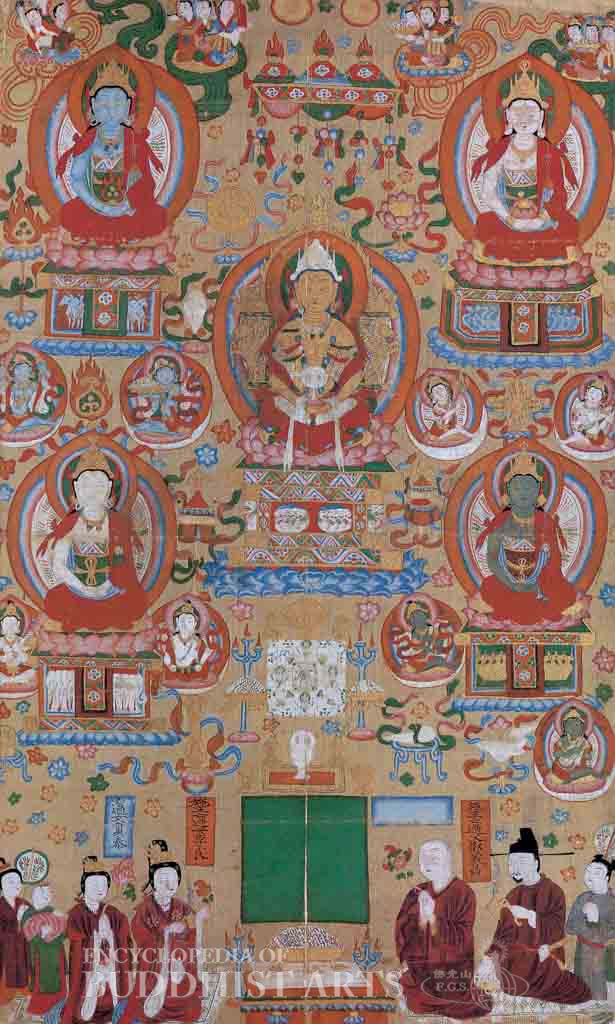
Mogao Cave 17: Five Dhyani Buddhas
Ink and color on silk
Mogao Cave 17: Five Dhyani Buddhas
CHINA, Gansu, Dunhuang; Northern Song dynasty
The Five Dhyani Buddhas, each represented in their symbolic color, are seated in full lotus position on lotus thrones in the upper register. The nimbuses and mandorlas of all five Buddhas are outlined with red. Except for Aksobhya on the lower left, all of them wear headdresses topped with thin spires, a detail only seen in paintings from Dunhuang. The gold Vairocana Buddha is in the center, backed by a decorative arch. A red stole is wrapped around the arms, and the hands support a white wheel. Ratnasambhava, depicted in the upper left corner, holds three flaming jewels. Amitabha is in the upper right corner holding a lotus flower. On the lower left, Aksobhya sits on a throne with elephants painted on the base, carrying a vajra. Amoghasiddhi, in the lower right corner, also holds a vajra. Golden garudas are painted on the base of Amoghasiddhi’s throne.
Two small Bodhisattvas making offerings are painted beside all of the Buddhas except for Vairocana. Groups of two or three Bodhisattvas stand on lotuses at the top of the picture. Flowers, canopies, and the eight auspicious symbols are painted between the figures. In the lower register, an empty green cartouche above an altar is flanked by seven male and female donors making offerings. This mandala, brightly colored and partly gilded, is a rare artwork dating from the second half of the 7th century.
For more details, go to the Encyclopedia of Buddhist Arts: Painting I-O, page 587.
Cite this article:
author = Hsingyun and Youheng and Youlu and Wilson, Graham and Manho and Mankuang and Huntington, Susan,
booktitle = {Encyclopedia of Buddhist Arts: Painting I-O},
pages = 587,
title = {{Mogao Cave 17: Five Dhyani Buddhas}},
volume = 15,
year = {2016}}