
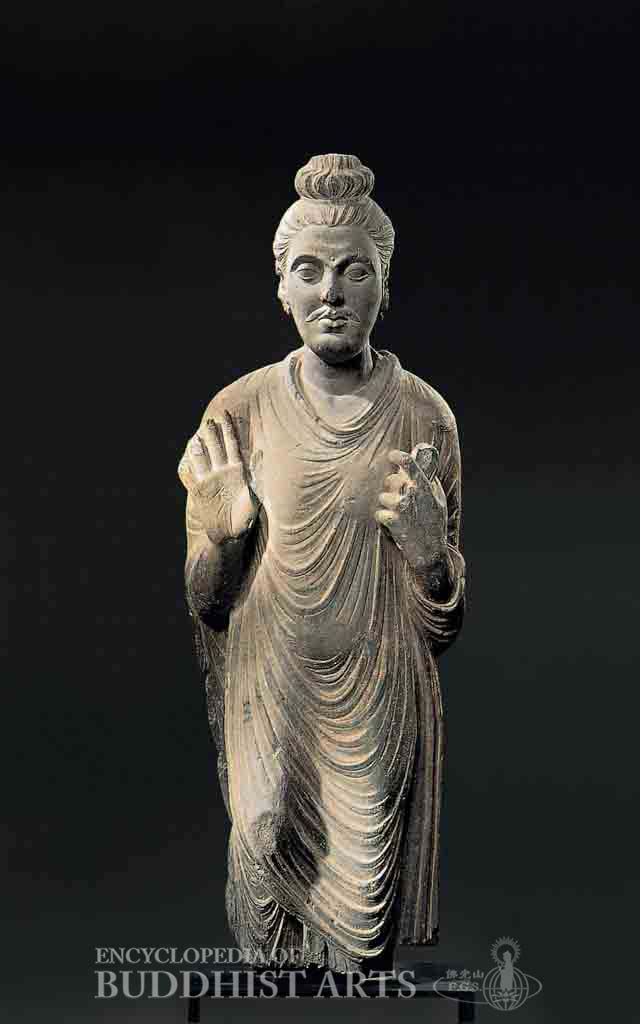
Standing Buddha
Schist
Standing Buddha
PAKISTAN
All the later characteristics of the Buddha’s portrayal are present in this early Gandharan artwork. The waved hair is built into the ornamental topknot that was eventually to become the conventional usnisa. The eyebrows are heavy, the eyes wide, and the mouth downturned beneath the mustache. The right hand is raised in abhaya (fearlessness) mudra, and a small Dharma wheel is visible on the palm. The left hand is held at the chest and tightens the turn of the monastic robe about that arm. The robe covers both shoulders and its folds follow the shape of the body making visible the slight bend in the right knee as though the figure is walking. This feeling of movement is a trait borrowed from Hellenistic and Roman art, distinguishing the Gandharan from the contemporary Mathura style.
For more details, go to the Encyclopedia of Buddhist Arts: Sculpture St-Z, page 1148.
Cite this article:
author = Hsingyun and Youheng and Lovelock, Yann and Chou, Yuan and Huntington, Susan and Edson, Gary and Neather, Robert,
booktitle = {Encyclopedia of Buddhist Arts: Sculpture St-Z},
pages = 1148,
title = {{Standing Buddha}},
volume = 13,
year = {2016}}