
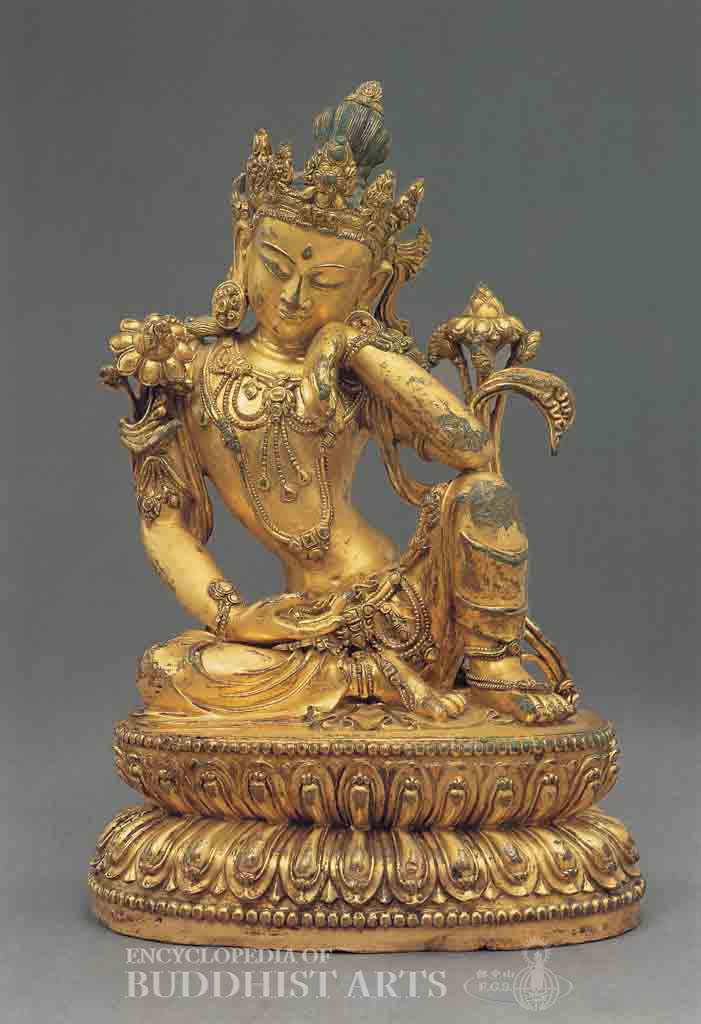
Seated Bodhisattva
Gilt copper alloy
Seated Bodhisattva
CHINA; Ming dynasty
An inscription on the pedestal dates the statue to the period of Emperor Yongle (reigned 1402–1424). The statue was made as an imperial gift to Buddhist leaders of the Mongolian and Tibetan regions.
The Bodhisattva is seated in the royal ease position upon a double lotus throne. A five-flower crown secures the figure’s hair that has been arranged into a jeweled topknot. The upper body is richly ornamented and is twisted into a pronounced tribhanga posture. This posture is accentuated by the position of the arms and the way the stole winds about the body. Lotuses are found on either side of the shoulders, consisting of a bud, a mature blossom and a seedpod, symbolizing the past, present and future.
For more details, go to the Encyclopedia of Buddhist Arts: Sculpture N-Sr, page 992.
Cite this article:
author = Hsingyun and Youheng and Lovelock, Yann and Chou, Yuan and Huntington, Susan and Edson, Gary and Neather, Robert,
booktitle = {Encyclopedia of Buddhist Arts: Sculpture N-Sr},
pages = 992,
title = {{Seated Bodhisattva}},
volume = 12,
year = {2016}}