
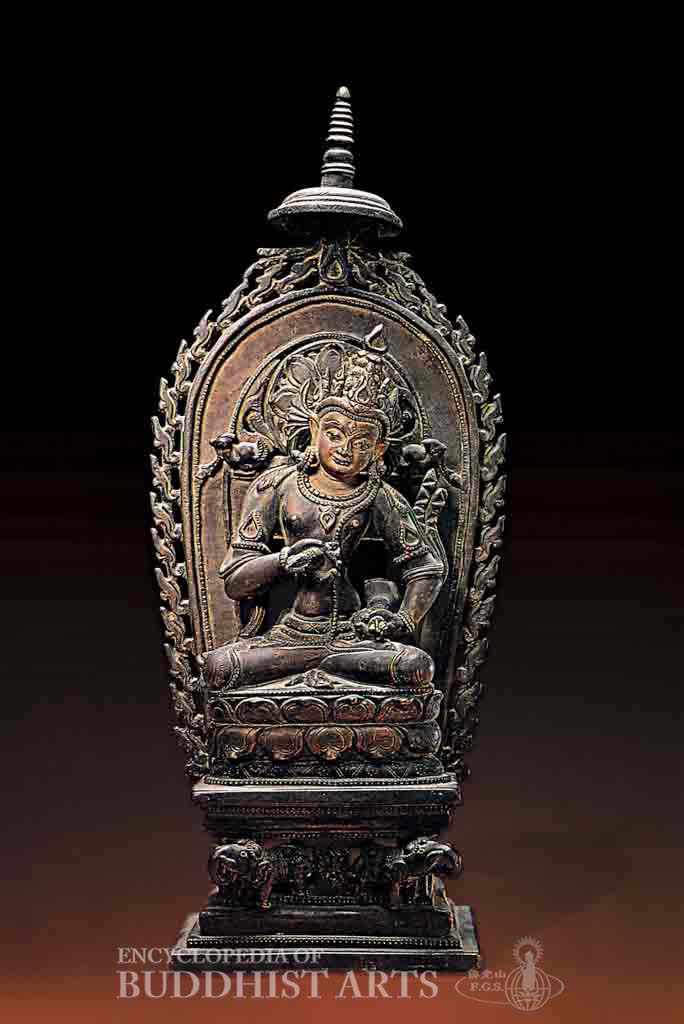
Vajrasattva
Brass
Vajrasattva
INDIA / BANGLADESH
Vajrasattva, presented in Bodhisattva form, is seated in full lotus position on a double lotus throne that is supported on an elephant base, the animal with which the figure is associated. The figure’s attributes, the vajra and bell, are held in the hands. The hair is swept into a high topknot that is secured by a five-leaf crown with indentations indicating each leaf was once inlaid with a gem. The arched mandorla is edged in flames with a canopy sitting at the top, surmounted by a stupa. The lotus nimbus is visible behind the Buddha’s head and is flanked by two birds with pearls held in their beaks. An inscription written on a yellow strip of material states the statue was taken into the palace in 1763 during the rule of Emperor Qianlong (reigned 1736–1795).
For more details, go to the Encyclopedia of Buddhist Arts: Sculpture St-Z, page 1299.
Cite this article:
author = Hsingyun and Youheng and Lovelock, Yann and Chou, Yuan and Huntington, Susan and Edson, Gary and Neather, Robert,
booktitle = {Encyclopedia of Buddhist Arts: Sculpture St-Z},
pages = 1299,
title = {{Vajrasattva}},
volume = 13,
year = {2016}}