
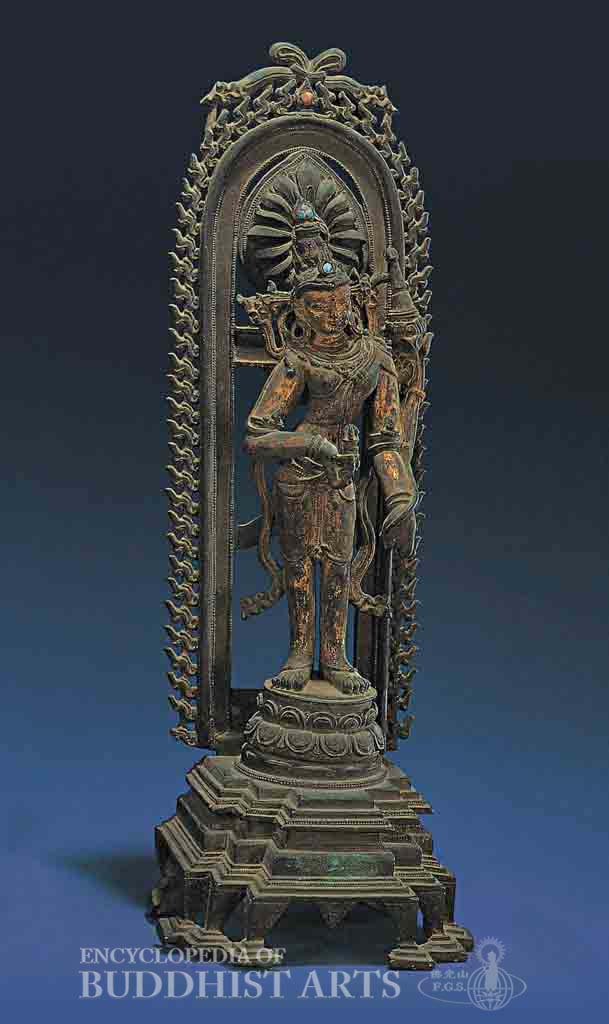
Vajrasattva
Gilt bronze
Vajrasattva
INDIA / BANGLADESH
The figure stands in the tribhanga posture with head and hips tilting to one side. The double lotus pedestal is positioned on a stepped and multi-angled base. The base is connected to a hollow arched mandorla rimmed with flames that in turn encloses a floral nimbus. The figure wears a headdress that sits high on the head and is inlaid with turquoises, while buoyant ribbons project from wide sidepieces. These design elements were popular during the later centuries of the Pala period (circa 8th–12th century). The figure’s left hand holds a long-stemmed lotus that supports a vajra-handled bell, while the right hand holds an upright vajra.
For more details, go to the Encyclopedia of Buddhist Arts: Sculpture St-Z, page 1298.
Cite this article:
Hsingyun, et al. "Vajrasattva." Encyclopedia of Buddhist Arts: Sculpture St-Z, vol. 13, 2016, pp. 1298.
Hsingyun, Youheng, Yann Lovelock, Yuan Chou, Susan Huntington, Gary Edson, and Robert Neather. 2016. "Vajrasattva" In Encyclopedia of Buddhist Arts: Sculpture St-Z, 13:1298.
Hsingyun, Youheng, Lovelock, Y., Chou, Y., Huntington, S., Edson, G., & Neather, R.. (2016). Vajrasattva. In Encyclopedia of Buddhist Arts: Sculpture St-Z (Vol. 13, pp. 1298).
@misc{Hsingyun2016,
author = Hsingyun and Youheng and Lovelock, Yann and Chou, Yuan and Huntington, Susan and Edson, Gary and Neather, Robert,
booktitle = {Encyclopedia of Buddhist Arts: Sculpture St-Z},
pages = 1298,
title = {{Vajrasattva}},
volume = 13,
year = {2016}}
author = Hsingyun and Youheng and Lovelock, Yann and Chou, Yuan and Huntington, Susan and Edson, Gary and Neather, Robert,
booktitle = {Encyclopedia of Buddhist Arts: Sculpture St-Z},
pages = 1298,
title = {{Vajrasattva}},
volume = 13,
year = {2016}}