
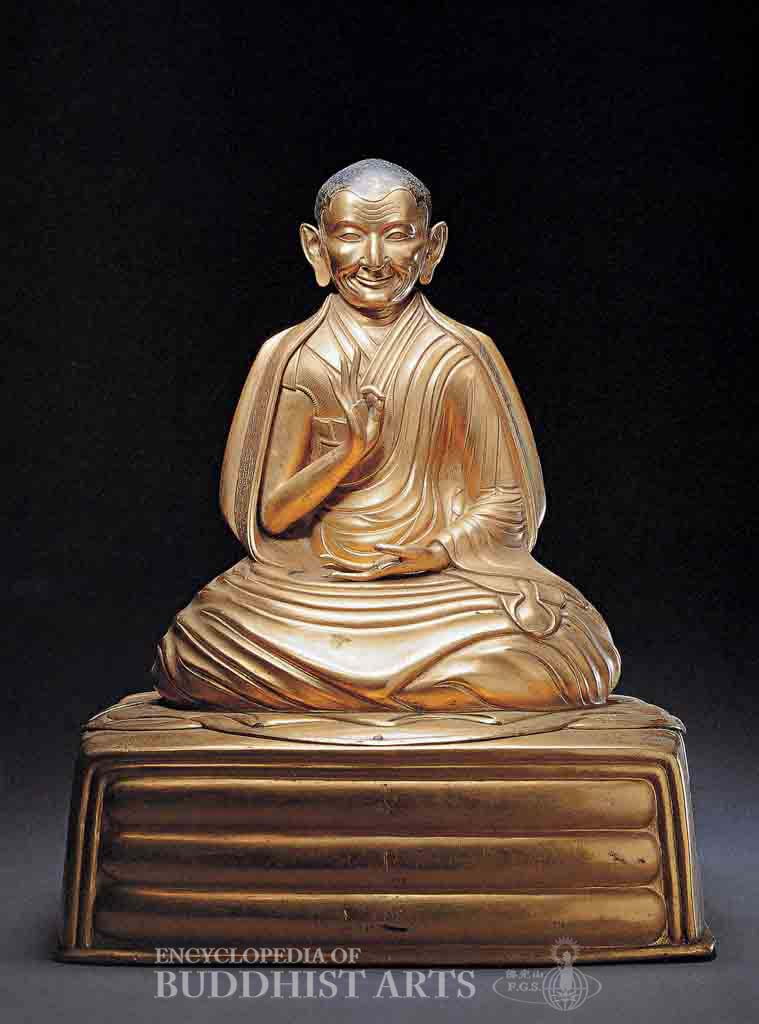
Jaya Pandita Losang
Gilt copper alloy
Jaya Pandita Losang
CHINA; Qing dynasty
Jaya Pandita Losang was a Buddhist missionary and diplomat of Oirat Mongol origin who was educated in Lhasa. He translated the Tibetan scriptures using the new alphabet of his invention known as Clear Script and made great contributions to the cultures of Mongolia and Tibet. The Fifth Dalai Lama commissioned craftsmen from Nepal to make the sculpture after Jaya Pandita’s death, according to the inscription engraved beneath this sculpture. The piece therefore has historical value.
The lama is portrayed in old age with a smiling face that highlights the wrinkles about the mouth and on the forehead. Over his monastic robes, an over-robe falls to cover his crossed legs as he sits on a triple-cushioned base with his right hand raised in vitarka (teaching) mudra.
For more details, go to the Encyclopedia of Buddhist Arts: Sculpture G-M, page 490.
Cite this article:
author = Hsingyun and Youheng and Lovelock, Yann and Chou, Yuan and Huntington, Susan and Edson, Gary and Neather, Robert,
booktitle = {Encyclopedia of Buddhist Arts: Sculpture G-M},
pages = 490,
title = {{Jaya Pandita Losang}},
volume = 11,
year = {2016}}