
Usnisavijaya
Gilt copper alloy
Usnisavijaya
CHINA; Qing dynasty
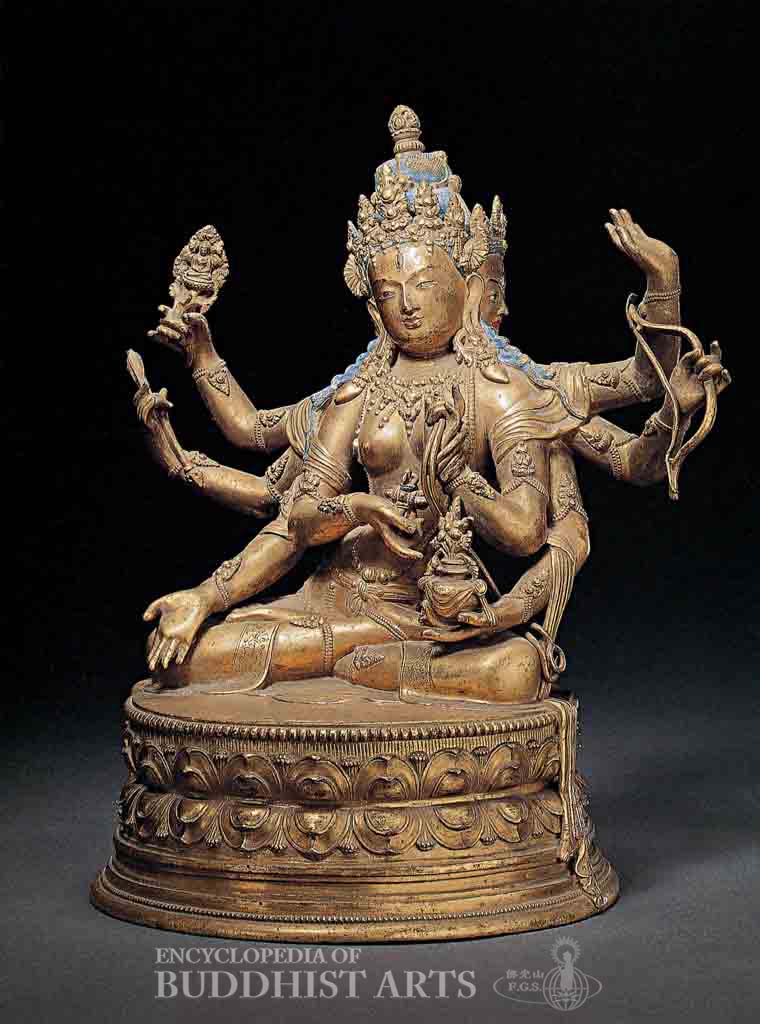
The sculpture, made between the 17th and 18th centuries, is a Khalkha-style work from northern Mongolia. Repetition of the deity’s dharani has the power to rid one of negative karmic hindrances according to the Usnisavijaya Dharani Sutra. The figure has three faces and eight arms. The center face is calm in appearance while the side, faces are wrathful, and each has a wisdom eye. A double vajra and a rope are held before the chest. Other objects or mudras, in a clockwise direction, are the varada (wish-granting) mudra, an arrow, a Buddha image, the abhaya (fearlessness) mudra, a bow, and a vase.
An ornate five-leaf diadem is worn by all the heads with a high topknot behind them and topped with a jewel. Locks of hair flow onto the shoulders and over the stole that winds down the arms and throne on which the figure is seated in full lotus position. The upper body is otherwise unclothed but a skirt is worn with a wide lower hem and decorated with floral patterns. Despite being seated, the figure is in the tribhanga posture. The double lotus throne is as ornate as the jewelry.
For more details, go to the Encyclopedia of Buddhist Arts: Sculpture St-Z, page 1279.
Cite this article:
author = Hsingyun and Youheng and Lovelock, Yann and Chou, Yuan and Huntington, Susan and Edson, Gary and Neather, Robert,
booktitle = {Encyclopedia of Buddhist Arts: Sculpture St-Z},
pages = 1279,
title = {{Usnisavijaya}},
volume = 13,
year = {2016}}