
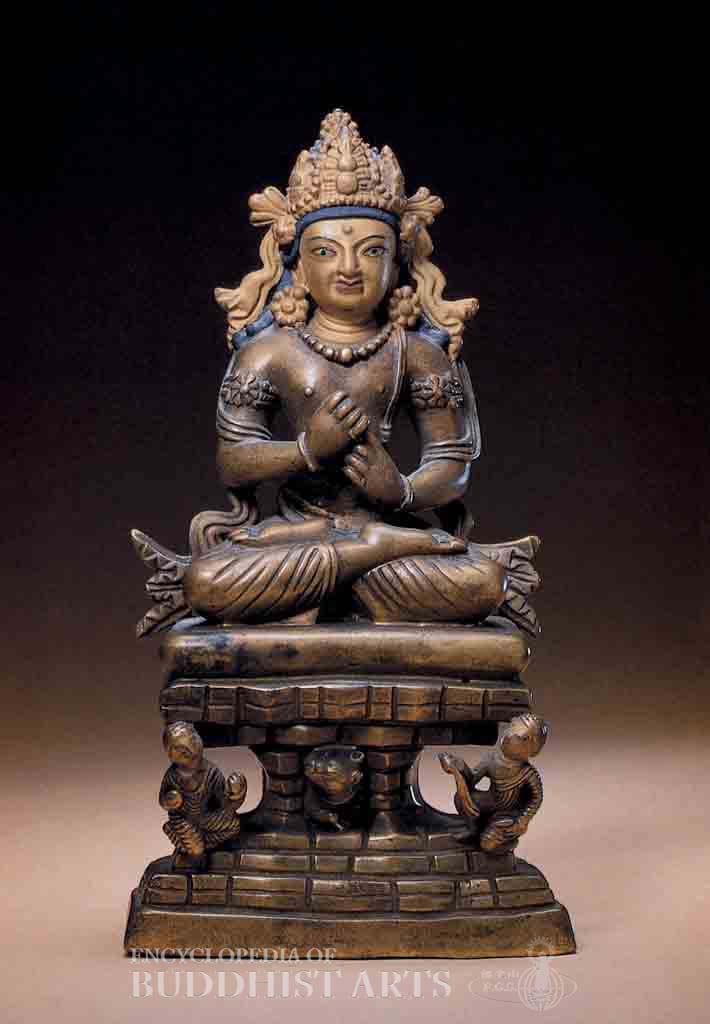
Vairocana Buddha
Brass
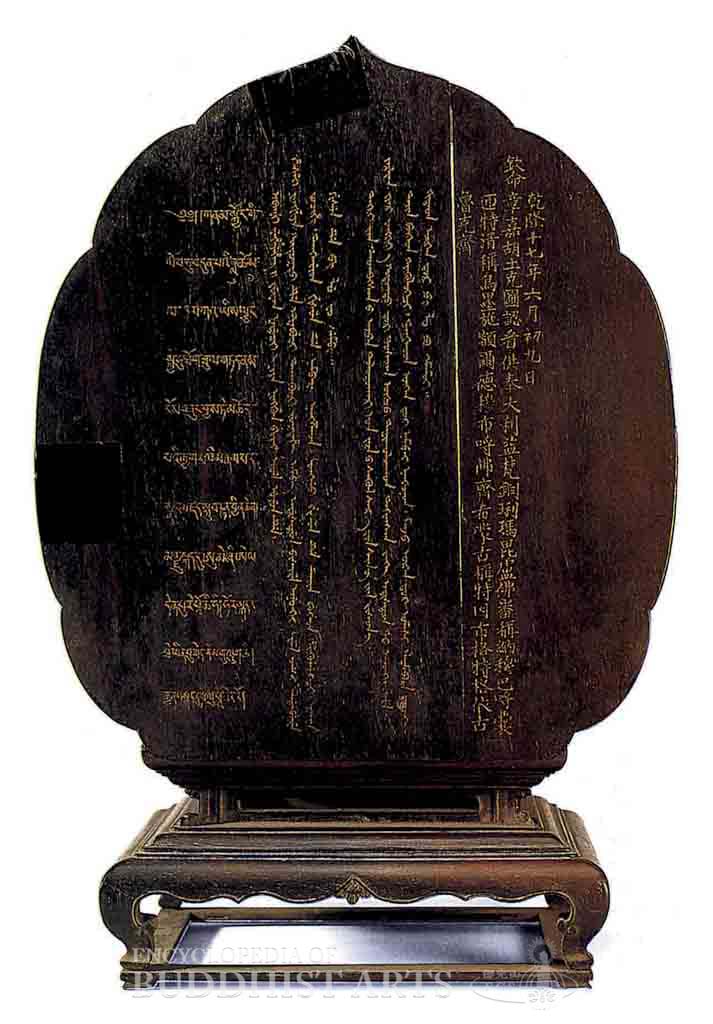
Vairocana Buddha (back)
Vairocana Buddha
CHINA
The statue was sculpted in the Kashmiri style. It was enshrined within a niche at the imperial palace during the Qing dynasty with a label stating that it was gifted in 1676 by the Second Changkya Khutukhtu. There are, however, inscriptions written in Chinese, Manchu, Mongol, and Tibetan on the back of the niche, stating that this Buddha was appraised by the Third Changkya Khutukhtu in 1752.
Vairocana wears a tall, elaborate headdress with ribbons falling from floral sidepieces. There are floral decorations on the earrings and bracelets as well. Signs of Buddhahood include an urna and the three lines on the neck, together with the bodhyangi (wisdom fist) mudra that identifies this Buddha. He is seated in full lotus position on a cushion resting on a lion throne. The lion sticks out his head from a lair at the center to peer at one of the monastic devotees kneeling at the corner.
For more details, go to the Encyclopedia of Buddhist Arts: Sculpture St-Z, page 1283.
Cite this article:
author = Hsingyun and Youheng and Lovelock, Yann and Chou, Yuan and Huntington, Susan and Edson, Gary and Neather, Robert,
booktitle = {Encyclopedia of Buddhist Arts: Sculpture St-Z},
pages = 1283,
title = {{Vairocana Buddha}},
volume = 13,
year = {2016}}