
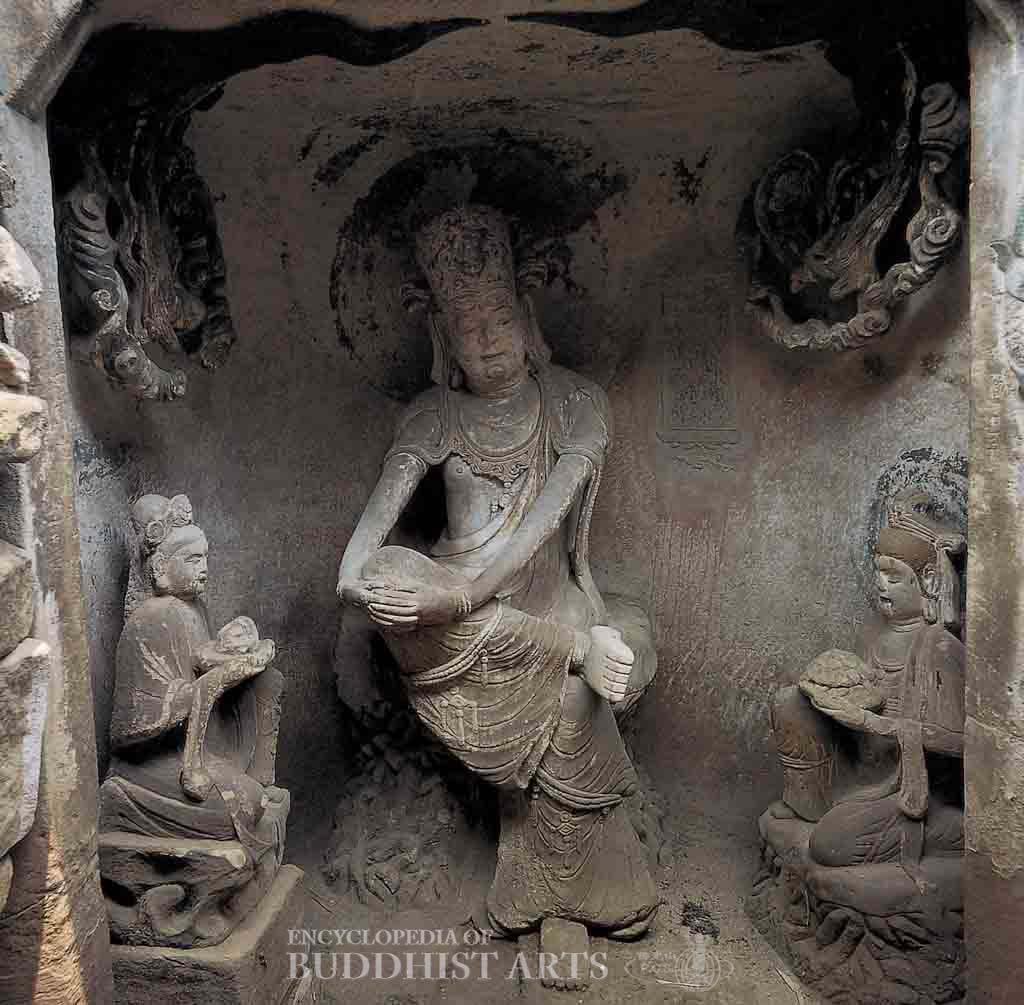
Shifo Temple Rock Carvings Niche 1: Avalokitesvara Bodhisattva
Shifo Temple Rock Carvings Niche 1
CHINA, Chongqing, Jiangjin
The niche was carved during the Northern Song dynasty (960–1127) and has an apsidal layout with a flat ceiling. It measures 1.97 m wide, 2.14 m high, and 1.22 m deep. In the center of the niche is a sculpture of Avalokitesvara Bodhisattva, who sits in the relaxation posture atop a Sumeru throne with both hands holding one knee. The figure is flanked by two Bodhisattvas making offerings, with apsaras above them.
Avalokitesvara, whose head is encircled by a round nimbus, wears a headdress with Amitabha Buddha in the center. The figure has a round face and the body is draped with various stoles. The Bodhisattva is further adorned with a necklace, armlets, and bracelets. The two attendant Bodhisattvas kneel on one knee and rest on Sumeru bases. Each of them holds a plate and wears stoles and a long skirt. There is an oval nimbus behind each Bodhisattva’s head. The apsaras wear dhotis and stoles.
There are three inscriptions within the niche, all of which are damaged. The first inscription states that the foot of Avalokitesvara was repaired in 1021. The second and third inscriptions claim that the niche underwent restorations in 1097 and 1407, respectively.
For more details, go to the Encyclopedia of Buddhist Arts: Caves Mo-S, page 1367.
Cite this article:
author = Hsingyun and Youheng and Johnson, Peter and Mankuang and Huntington, Susan and Edson, Gary and Neather, Robert,
booktitle = {Encyclopedia of Buddhist Arts: Caves Mo-S},
pages = 1367,
title = {{Shifo Temple Rock Carvings Niche 1}},
volume = 8,
year = {2016}}