
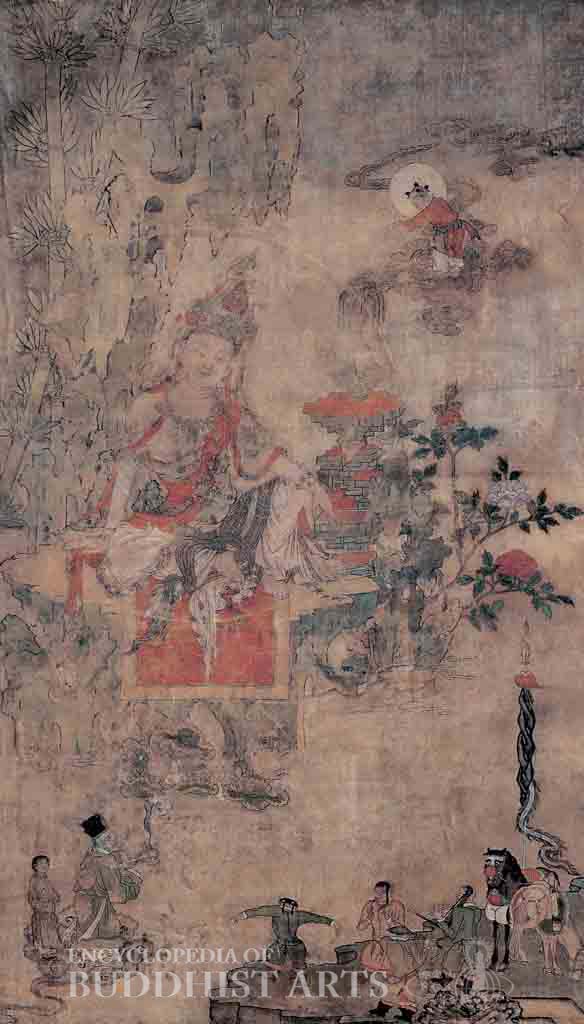
Khara Khoto: Water-Moon Avalokitesvara
Ink and color on silk

Khara Khoto: Water-Moon Avalokitesvara - Sudhana

Khara Khoto: Water-Moon Avalokitesvara - Figures Making Offerings
Khara Khoto: Water-Moon Avalokitesvara
CHINA, Inner Mongolia, Alxa; Western Xia period
Water-Moon Avalokitesvara wears a tall headdress draped with silk, a dhoti with flowing folds, and several ornaments. The peaceful Bodhisattva is seated in royal ease posture on a rock beside the water. A vase holding a willow branch rests on a rocky outcrop to the right of Avalokitesvara. The large mandorla is painted with a faint line.
In the bottom left corner of the painting, there is a man wearing an official’s hat and robe, accompanied by a child attendant. The man holds an incense burner, from which smoke rises up into the shape of a lotus. Four figures dressed in the style of the Tanguts of the Western Xia period are depicted in the bottom right corner. Two of the figures play music, one claps his hands, and the other dances. Two horses stand beside the figures, one with a distinctive red cover on the front of the bridle. In many depictions of Water-Moon Avalokitesvara, Sudhana is painted at the bottom of the picture, but here he is shown above the Bodhisattva, floating on clouds with his palms joined in reverence. Bamboo, flowers, and an overhanging rock are painted beside the central figure in a style that suggests the influence of Song dynasty (960–1279) art.
For more details, go to the Encyclopedia of Buddhist Arts: Painting I-O, page 433.
Cite this article:
author = Hsingyun and Youheng and Youlu and Wilson, Graham and Manho and Mankuang and Huntington, Susan,
booktitle = {Encyclopedia of Buddhist Arts: Painting I-O},
pages = 433,
title = {{Khara Khoto: Water-Moon Avalokitesvara}},
volume = 15,
year = {2016}}