
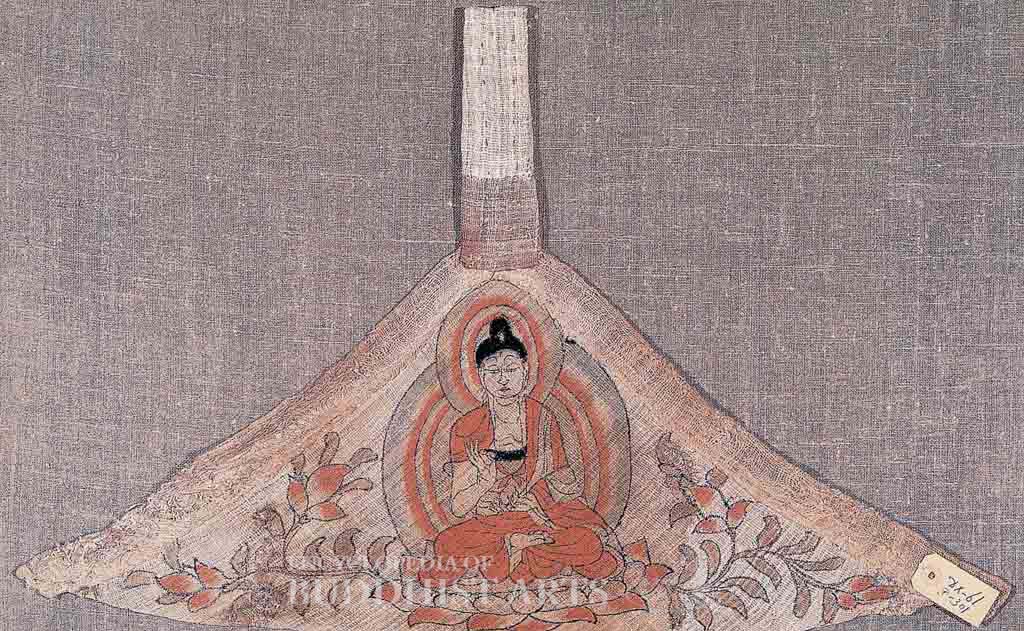
Mogao Cave 17: Seated Buddha
Ink and color on linen

Mogao Cave 17: Seated Buddha (detail)
Mogao Cave 17: Seated Buddha
CHINA, Gansu, Dunhuang; Five Dynasties
The banner, known in Sanskrit as a “pataka” or “ketu,” was used in ancient India as a symbol of authority and to command soldiers. It was adopted in Buddhism to signify the Buddha’s subduing power over Mara. This triangular headpiece, discovered in Mogao Cave 17, has a Buddha image on both sides. On the front of the headpiece, the Buddha sits on a lotus throne with his right hand probably displaying the vitarka (teaching) mudra and the left hand holding a lotus bud. The image on the reverse face is similar, but the Buddha is depicted with the left hand on the knee.
For more details, go to the Encyclopedia of Buddhist Arts: Painting I-O, page 653.
Cite this article:
Hsingyun, et al. "Mogao Cave 17: Seated Buddha." Encyclopedia of Buddhist Arts: Painting I-O, vol. 15, 2016, pp. 653.
Hsingyun, Youheng, Youlu, Graham Wilson, Manho, Mankuang, and Susan Huntington. 2016. "Mogao Cave 17: Seated Buddha" In Encyclopedia of Buddhist Arts: Painting I-O, 15:653.
Hsingyun, Youheng, Youlu, Wilson, G., Manho, Mankuang, & Huntington, S.. (2016). Mogao Cave 17: Seated Buddha. In Encyclopedia of Buddhist Arts: Painting I-O (Vol. 15, pp. 653).
@misc{Hsingyun2016,
author = Hsingyun and Youheng and Youlu and Wilson, Graham and Manho and Mankuang and Huntington, Susan,
booktitle = {Encyclopedia of Buddhist Arts: Painting I-O},
pages = 653,
title = {{Mogao Cave 17: Seated Buddha}},
volume = 15,
year = {2016}}
author = Hsingyun and Youheng and Youlu and Wilson, Graham and Manho and Mankuang and Huntington, Susan,
booktitle = {Encyclopedia of Buddhist Arts: Painting I-O},
pages = 653,
title = {{Mogao Cave 17: Seated Buddha}},
volume = 15,
year = {2016}}