
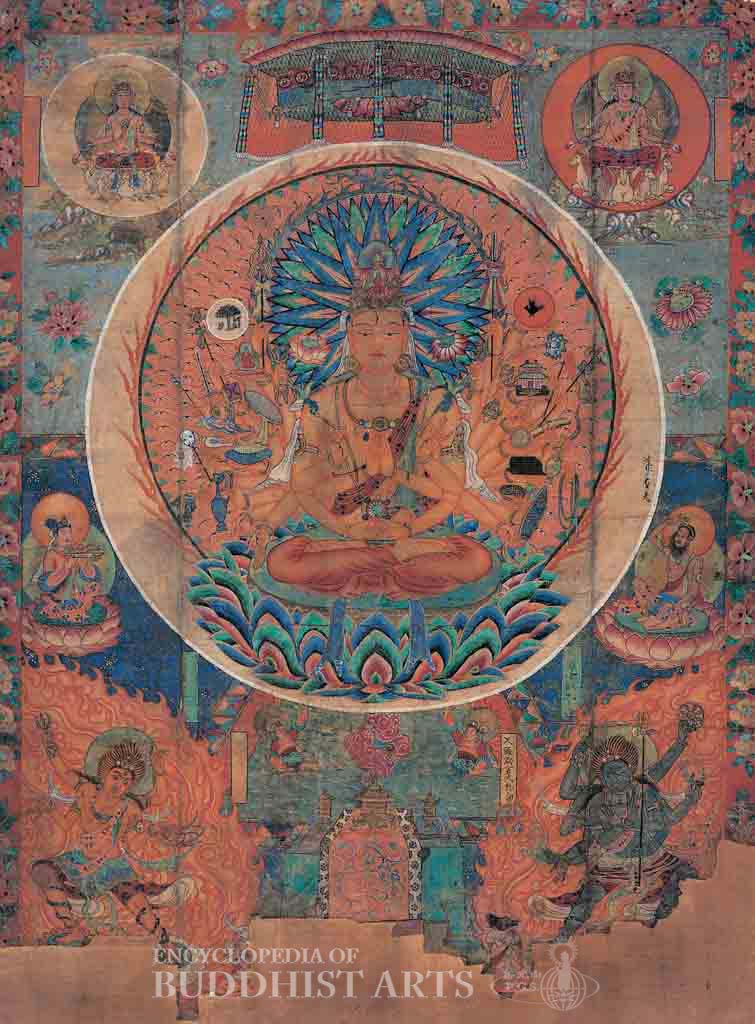
Mogao Cave 17: Thousand-Armed, Thousand-Eyed Avalokitesvara
Ink and color on silk
Mogao Cave 17: Thousand-Armed, Thousand-Eyed Avalokitesvara
CHINA, Gansu, Dunhuang; Tang dynasty
This Late Tang period (846–907) painting shows the Thousand-Armed, Thousand-Eyed Avalokitesvara Bodhisattva sitting in full lotus position on a lotus throne within a large mandorla. The Bodhisattva wears a headdress adorned with a Buddha image and has a third eye on the forehead. White ribbons attached to the headdress hang over the shoulders. The nimbus and throne are uniquely formed with overlapping triangles in vivid colors. In front of the chest, one pair of hands hold lotuses, another joins palms, and a third forms the dhyana (meditation) mudra. The remaining hands, each with an eye on the palm, are arranged in a circle. The more prominent hands closer to the body hold Dharma implements including a sun disc, a moon disc, and a vase.
In the upper right corner, Surya, representing the sun, sits atop five white horses. Candra, representing the moon, is supported by geese. A strip of patterning divides the background into two sections; the upper half is pale gray, while the lower half is deep blue. Just below this dividing line, there are depictions of Mahadevi on the left, kneeling on a lotus throne holding up offerings, and the bearded Vasu on the right, identified by Chinese characters within Avalokitesvara’s mandorla. Two naga kings, Nanda and Bananda, rise from a pond in the middle of the lower register. In the lower corners, two Dharma protectors with multiple arms stand in the warrior stance, backed by vivid orange flames. The bottom piece of the picture has been torn away and is kept separately in the State Hermitage Museum in Russia.
For more details, go to the Encyclopedia of Buddhist Arts: Painting I-O, page 669.
Cite this article:
author = Hsingyun and Youheng and Youlu and Wilson, Graham and Manho and Mankuang and Huntington, Susan,
booktitle = {Encyclopedia of Buddhist Arts: Painting I-O},
pages = 669,
title = {{Mogao Cave 17: Thousand-Armed, Thousand-Eyed Avalokitesvara}},
volume = 15,
year = {2016}}