
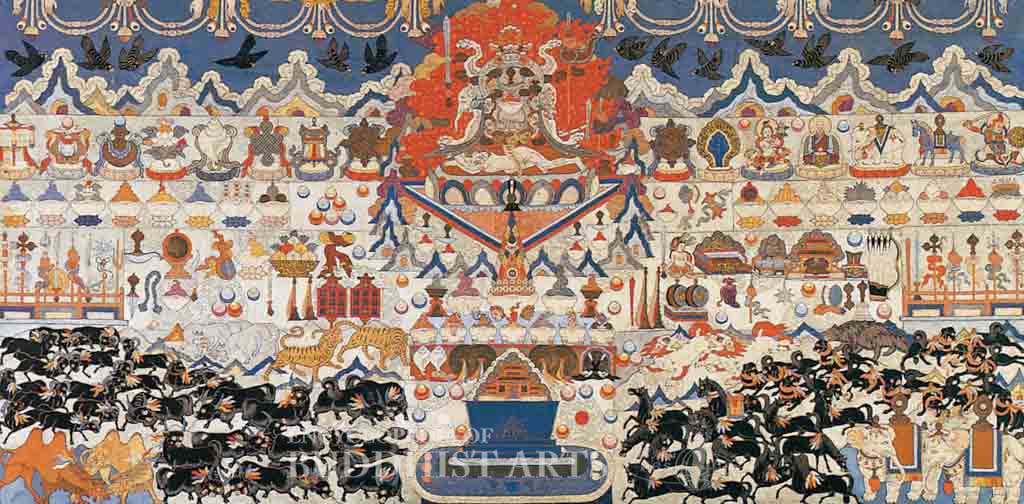
Embroidery of Offerings to Mahakala
Silk

Embroidery of Offerings to Mahakala - Seven Treasures of the Cakravartin
Embroidery of Offerings to Mahakala
MONGOLIA
This late 19th century embroidery depicts offerings to Mahakala. The central image at the top depicts the attributes of Mahakala, while he is not actually shown. He is represented by a five-skull crown, stole, elephant skin, skeleton garland, sword, and pike. He would normally stand on the prostrate figure lying on a lotus pedestal. Below, there is an altar with two rows of offerings. The first row has a triangular torma in the middle, with pairs of skull bowls filled with blood and butter lamps on each side. The second row has seven skull bowls. Beneath the altar are several pairs of musical instruments. At the bottom, there is a depiction of Mount Sumeru, with representations of the four continents.
The remainder of the embroidery is divided into five registers. The top of the upper register has hanging drapery with 13 black birds flying above mountain peaks. One of them carries a human eyeball, and two others have human entrails in their beaks. The left side of the next register features the eight auspicious symbols; a parasol, two golden fish, vase, lotus, conch shell, eternal knot, victory banner, and Dharma wheel. On the right are the seven treasures of the cakravartin, which include the Dharma wheel, jewel, elephant, horse, minister, general, and queen. The next register has food offerings in skull bowls on both sides, while below displays ritual weapons, musical instruments, and the seven secondary treasures of the cakravartin, which are a sword, hide, throne, house, robe, and shoes. The bottom register contains various animals, including horses, cattle, snow lions, camels, and elephants.
This applique embroidery was created on silk using a variety of stitching techniques, such as cross stitch, stem stitch and patchwork. The composition is well-balanced and presents a wide variety of offerings in a systematic way.
For more details, go to the Encyclopedia of Buddhist Arts: Artifacts, page 78.
Cite this article:
author = Hsingyun and Youheng and Youji and Pokorski, Stefanie and Mankuang and Fan, Wen,
booktitle = {Encyclopedia of Buddhist Arts: Artifacts },
pages = 78,
title = {{Embroidery of Offerings to Mahakala}},
volume = 18,
year = {2016}}