
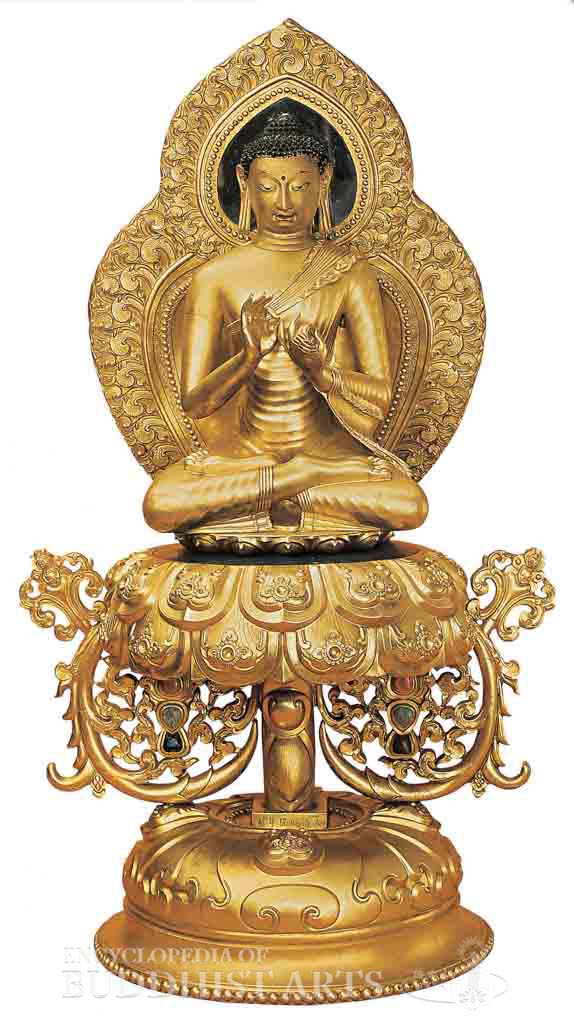
Seated Buddha
Gold
Seated Buddha
CHINA; Qing dynasty
The Buddha sits in full lotus position with hands in the Dharmacakra (Dharma wheel) mudra. The face has features similar to Kashmiri sculptures. The usnisa is well defined with a gem located at the very top. The shoulders are wide and the waist slim. a tight-fitting monastic robe covers the left shoulder and mostly hides the waist. There are decorative frills along the garment hem at the shoulders and arms. The aureole and nimbus interlock and are contained within a mandorla that is filled with intricate floral motifs. The cushion is perched on a reversed lotus throne that has vine-like decorations sprouting out from the stem, which in turn is joined to a round base.
The base is dated with an inscription, which refers to the time of Emperor Qianlong (reigned 1736–1795). Buddhist sculptures were made in abundance during Emperor Qianlong’s era; most of the designs were overtly simplified and lacked detail. However, this statue was sculpted under imperial order so great attention was given over to the details.
For more details, go to the Encyclopedia of Buddhist Arts: Sculpture N-Sr, page 1015.
Cite this article:
author = Hsingyun and Youheng and Lovelock, Yann and Chou, Yuan and Huntington, Susan and Edson, Gary and Neather, Robert,
booktitle = {Encyclopedia of Buddhist Arts: Sculpture N-Sr},
pages = 1015,
title = {{Seated Buddha}},
volume = 12,
year = {2016}}