
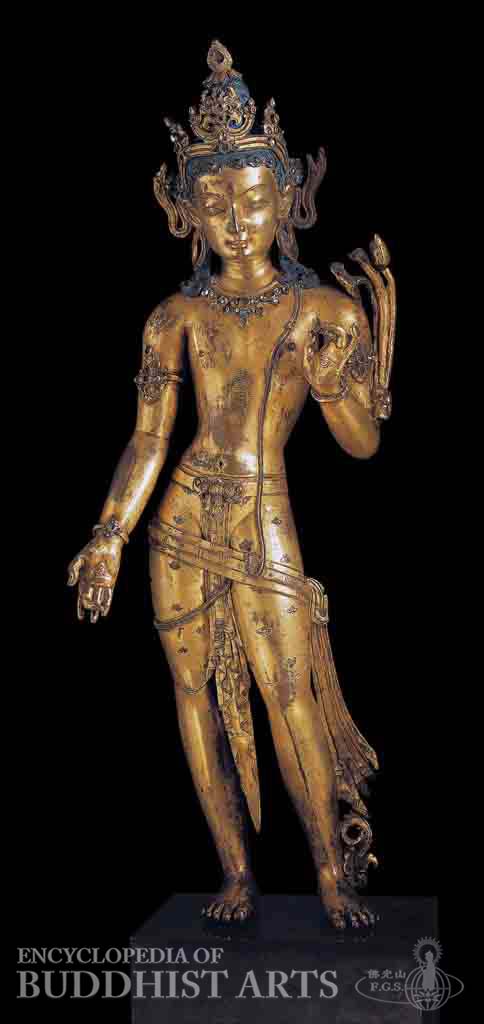
Standing Bodhisattva
Gilt copper alloy
Standing Bodhisattva
NEPAL; Malla dynasty
This statue, from early Malla dynasty, was at one time inlaid with semi-precious stones. The ringleted hair is built into a tall topknot ornamented with a gem and falls to the shoulders. Surmounting the head is a three-leaf crown with sidepieces in the form of fluttering ribbons. Ribbons found in this style only began to appear towards the end of the 11th century of the Pala period (circa 8th–12th century), which at that time exerted a strong cultural influence on Nepal.
The Bodhisattva stands with left foot outstretched in a tribhanga posture that moves the hips and head to the left. The right hand is in a variation of the varada (wish-granting) mudra with the middle finger slightly bent. A lotus-patterned Dharma wheel is visible on the palm. The left hand is raised and at one time held the stems of three lotuses. This attribute suggests that the statue depicts Avalokitesvara.
For more details, go to the Encyclopedia of Buddhist Arts: Sculpture St-Z, page 1128.
Cite this article:
author = Hsingyun and Youheng and Lovelock, Yann and Chou, Yuan and Huntington, Susan and Edson, Gary and Neather, Robert,
booktitle = {Encyclopedia of Buddhist Arts: Sculpture St-Z},
pages = 1128,
title = {{Standing Bodhisattva}},
volume = 13,
year = {2016}}