
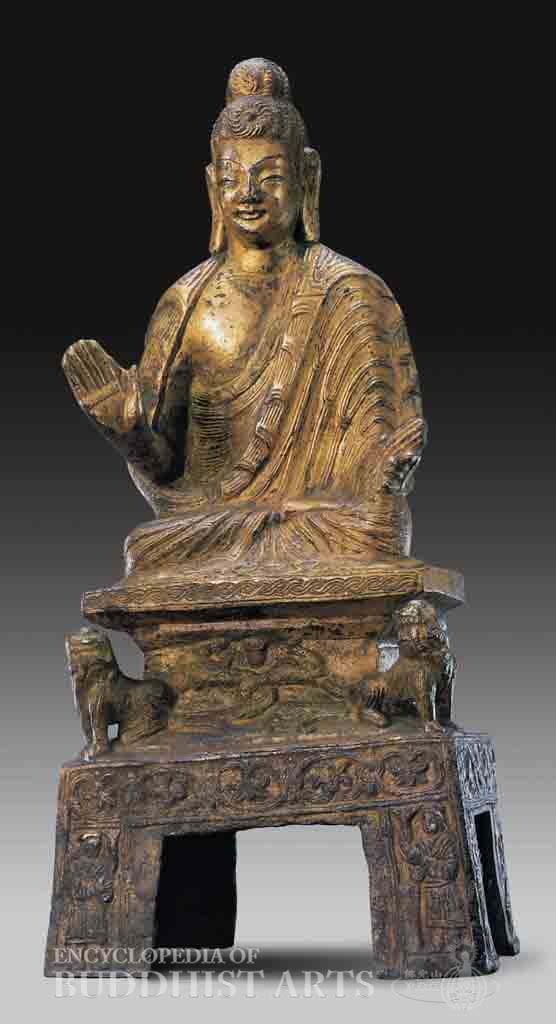
Hohhot: Sakyamuni Buddha
Gilt bronze
Hohhot: Sakyamuni Buddha
CHINA, Inner Mongolia, Hohhot; Northern Wei dynasty
The statue was discovered in Hohhot in 1956. The stylized Buddha figure is depicted with a high topknot and unusually long earlobes that almost brush the shoulders. Seated in full lotus position, the Buddha has his right hand lifted in abhaya (fearlessness) mudra. The inner monastic robe is partly covered by an outer robe that drapes both shoulders. Mortice holes on the back indicate that there was once a mandorla attached. The elaborate lion throne is supported on a four-legged stand with foliate patterns and reliefs of Bodhisattvas making offerings on the legs. An inscription on the back of the statue dates it to 484 and states that it was commissioned by the monk Seng’an.
For more details, go to the Encyclopedia of Buddhist Arts: Sculpture G-M, page 433.
Cite this article:
author = Hsingyun and Youheng and Lovelock, Yann and Chou, Yuan and Huntington, Susan and Edson, Gary and Neather, Robert,
booktitle = {Encyclopedia of Buddhist Arts: Sculpture G-M},
pages = 433,
title = {{Hohhot: Sakyamuni Buddha}},
volume = 11,
year = {2016}}