
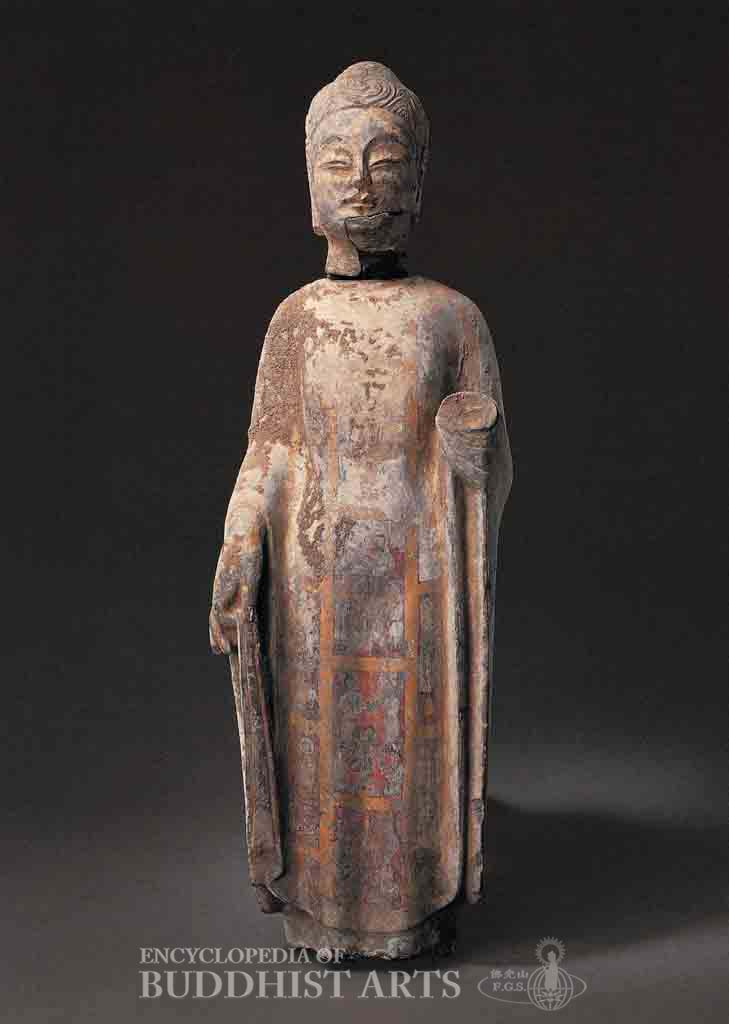
Mingdao Temple Pagoda Sculptures: Standing Buddha; Northern Qi dynasty; Limestone
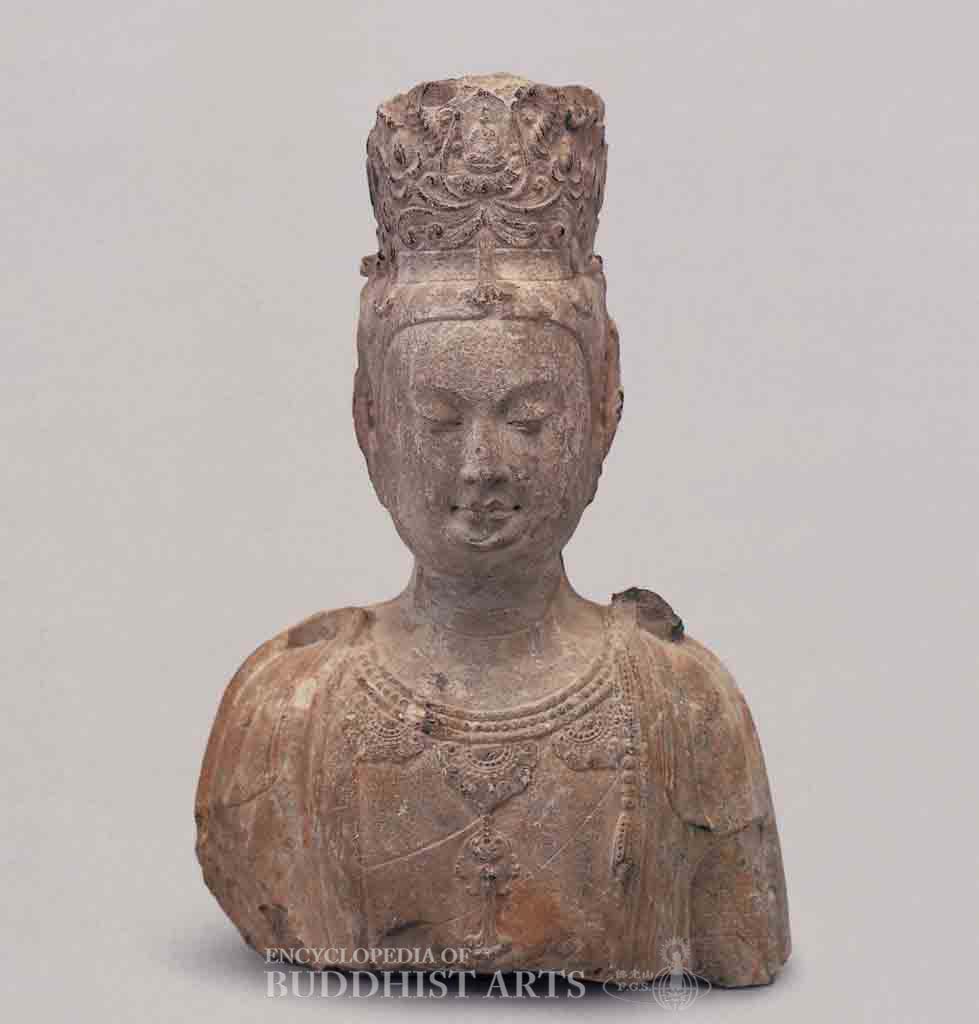
Mingdao Temple Pagoda Sculptures: Bust of Avalokitesvara Bodhisattva; Northern Qi dynasty; Limestone
Mingdao Temple Pagoda Sculptures
CHINA, Shandong, Weifang
These statues were among the discoveries in the pagoda’s underground palace; of which, half consisted of Buddha statues, with a few standing and contemplative Bodhisattvas. There were also some Buddha triads as well as steles or single Buddhas or Bodhisattvas with back screens. Some sculptures had dates on the back or the bases, with the earliest between 520 to 525 of the Northern Wei dynasty, and the latest dated 607 of the Sui dynasty. The main material used was blue limestone, with only a small number of the pieces made from marble or unglazed white ceramic.
A standing Buddha from the Northern Qi dynasty (550–577) wears a patchwork monastic robe that shows the remains of brilliantly colored Buddhist stories. Another sculpture of Avalokitesvara has only the head and chest remaining. Apparent in its intricate carving is a headdress with foliate patterns and a seated Amitabha at the top. A necklace with pendants is also represented in very detailed bas relief. It has a close resemblance to a Bodhisattva from the Northern Qi dynasty unearthed at Longxing Temple and may belong to that era.
For more details, go to the Encyclopedia of Buddhist Arts: Sculpture G-M, page 722.
Cite this article:
author = Hsingyun and Youheng and Lovelock, Yann and Chou, Yuan and Huntington, Susan and Edson, Gary and Neather, Robert,
booktitle = {Encyclopedia of Buddhist Arts: Sculpture G-M},
pages = 722,
title = {{Mingdao Temple Pagoda Sculptures}},
volume = 11,
year = {2016}}