
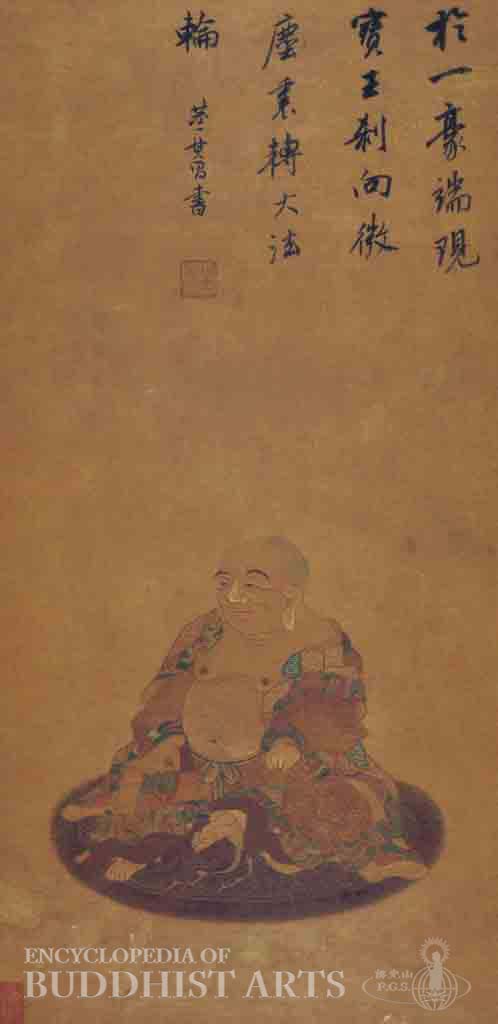
Embroidery of Maitreya Buddha by Han Ximeng; Ming dynasty
Silk
Han Ximeng
CHINA, Zhejiang, Hangzhou; Ming dynasty
Han Ximeng was born in Wulin, Zhejiang (present day Hangzhou, Zhejiang). The wife of Gu Shouqian, she was an embroidery artist who named her style after the Gu family garden “Luxiangyuan,” but it was often simply referred to as Gu Embroidery. In addition to embroidery, Han was a skilled calligrapher and painter. Famous paintings from the Song (960–1279) and Yuan (1271–1368) dynasties served as the basis for her works of embroidery. Due to Han’s various techniques of needle work, in addition to her concise depictions of landscapes, nature, and figures, her embroidery works exude a sense of vitality.
Han’s well-know embroidery pieces include Flowers and Birds and Maitreya Buddha, which are retained at the Liaoning Museum in Shenyang. The Embroidery of Maitreya Buddha is uniquely embroidered with combined threads to create a vigorous and imposing appearance.
Sixteen other pieces by Han are featured in the album of Embroidered Famous Painting from Song and Yuan. A beautifully embroidered piece which features the use of colorful silk threads on white silk fabric, with a slight ink wash and red silk embroidered characters, is attributed to Han, in addition to others, and currently kept at the Palace Museum in Beijing.
For more details, go to the Encyclopedia of Buddhist Arts: People, page 89.
Cite this article:
author = Hsingyun and Youheng and Youlu and Pokorski, Stefanie and Yichao and Mankuang and Miaohsi,
booktitle = {Encyclopedia of Buddhist Arts: People },
pages = 89,
title = {{Han Ximeng}},
volume = 19,
year = {2016}}