
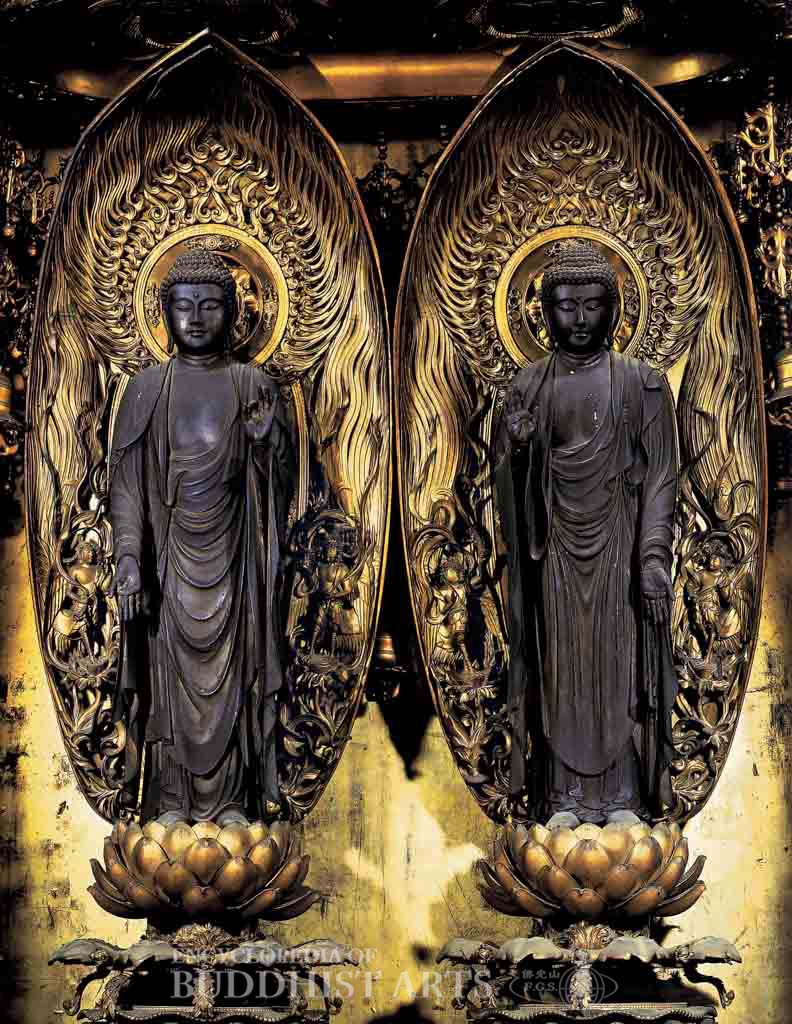
Nisonin Temple Main Hall: Sakyamuni and Amitabha Buddhas
Cypress wood
Nisonin Temple Main Hall: Sakyamuni and Amitabha Buddhas
JAPAN, Kyoto; Kamakura period
These sculptures have been listed as Important Cultural Properties. Sakyamuni Buddha is on the right with Amitabha Buddha on the left. The statues were assembled using pieces of cypress wood, the necks connected with tenons and the eyes inlaid with semi-precious stone. The surfaces were once coated with gold and painted, but little of the surface treatment remains. Their style dates from around the mid-13th century.
The right hand of Sakyamuni is lifted in abhaya (fearlessness) mudra and the left is open in varada (wish-granting) mudra. Amitabha is almost a mirror image, the left hand lifted in vitarka (teaching) mudra and the right making the varada mudra. The figures are chiefly differentiated by the style of their robes. The drapery is carved with fluttering folds, a distinctive feature in standing Buddha sculptures from the Kamakura period (1185–1333). Both figures stand with feet parallel on multi-layered lotus pedestals and are enclosed in tall, flame-like mandorlas with a burning nimbus radiating behind their heads. Beings entering this world cluster about Sakyamuni’s feet, while Amitabha welcomes them to the other shore.
For more details, go to the Encyclopedia of Buddhist Arts: Sculpture N-Sr, page 766.
Cite this article:
author = Hsingyun and Youheng and Lovelock, Yann and Chou, Yuan and Huntington, Susan and Edson, Gary and Neather, Robert,
booktitle = {Encyclopedia of Buddhist Arts: Sculpture N-Sr},
pages = 766,
title = {{Nisonin Temple Main Hall: Sakyamuni and Amitabha Buddhas}},
volume = 12,
year = {2016}}