
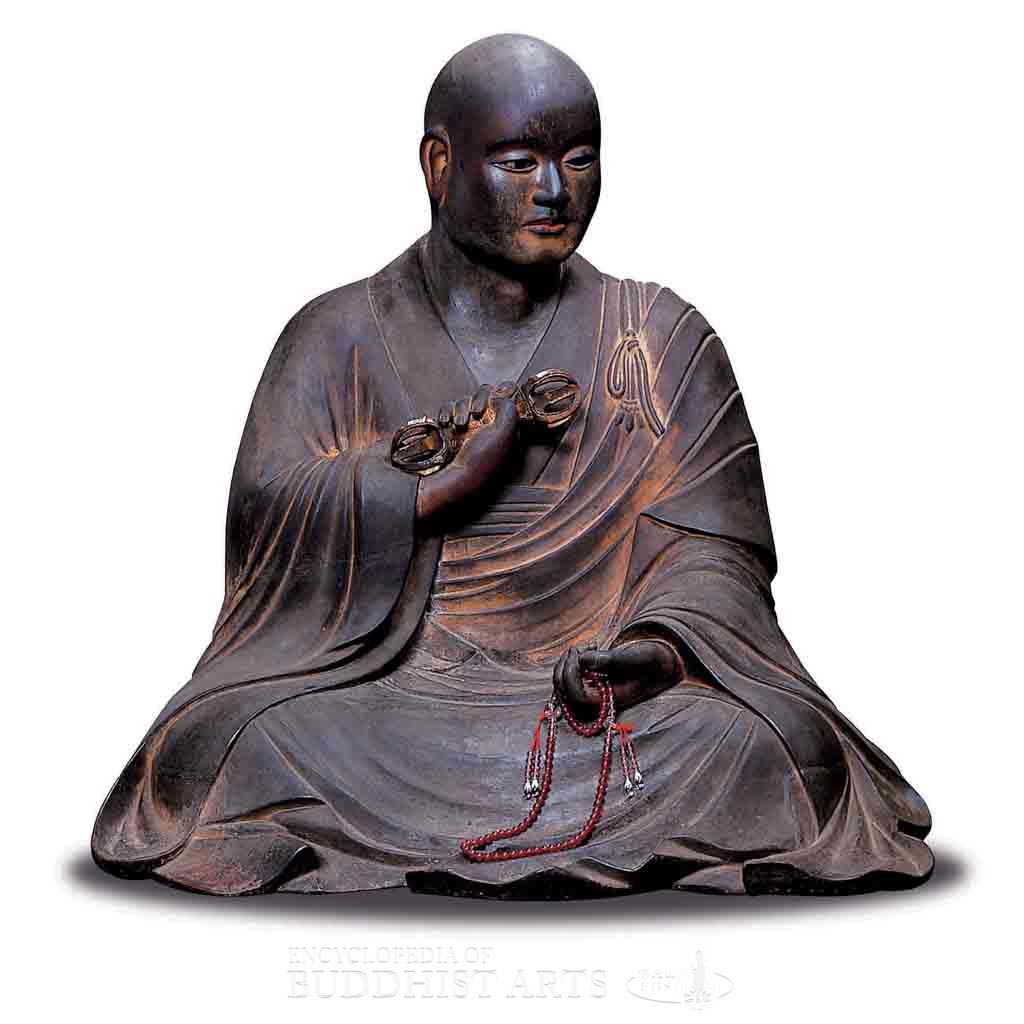
Kongobuji Temple: Master Kukai
Wood
Kongobuji Temple: Master Kukai
JAPAN, Wakayama, Ito; Muromachi to Momoyama period
Traditional portraits of Master Kukai were used as a basis for this statue a millennium later. It is alternatively known as “Master of Ten Thousand Days” in reference to the story that it was carved after the monastics practiced diligently for 10,000 days. The statue is listed as an Important Cultural Property. The figure’s shaved head is slightly turned to one side as he sits cross-legged in monastic robes. Though the eyes are open, the expression is one of inward concentration. The five-pronged vajra held in the right hand and the prayer beads that are wound around the left hand add to this impression. The overall presentation is simple and natural, but it is also a graphic portrayal of this Master’s qualities.
For more details, go to the Encyclopedia of Buddhist Arts: Sculpture G-M, page 555.
Cite this article:
author = Hsingyun and Youheng and Lovelock, Yann and Chou, Yuan and Huntington, Susan and Edson, Gary and Neather, Robert,
booktitle = {Encyclopedia of Buddhist Arts: Sculpture G-M},
pages = 555,
title = {{Kongobuji Temple: Master Kukai}},
volume = 11,
year = {2016}}