
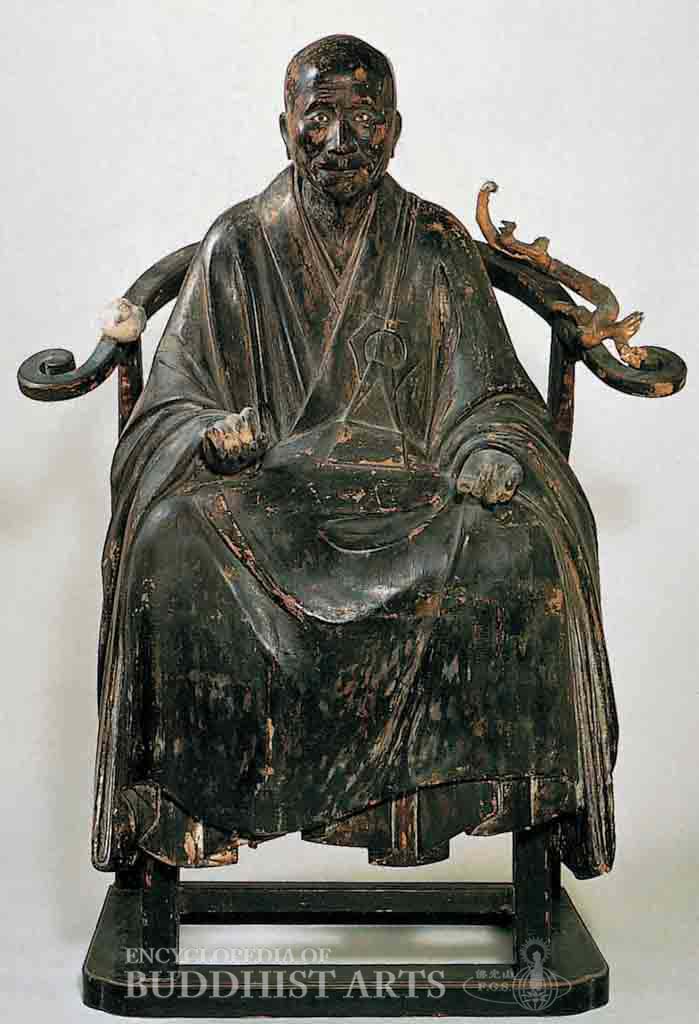
Engakuji Temple Founder’s Hall: Master Wuxue Zuyuan
Wood
Engakuji Temple Founder’s Hall: Master Wuxue Zuyuan
JAPAN, Kanagawa, Kamakura; Kamakura period
The statue is enshrined in the founder’s hall of Engakuji Temple and is listed as an Important Cultural Treasure. It is thought to have been made near the death of Master Wuxue Zuyuan, who was a Chan monk from the Southern Song (1127–1279) dynasty of China. Master Wuxue Zuyuan was invited to Japan by Hojo Tokimune, in 1279, to comfort the spirits of those who died resisting the Yuan invasion. The title National Master Bukko was conferred on him after his death.
The smaller than life-size statue has eyes inlaid with gems and was painted. The face appears severe but amiable, with a creased forehead, vigorous eyes and tightly closed mouth. The figure originally held a whisk, now lost. He is seated cross-legged on an armchair, and wearing monastic robes. The style of the sleeves, the drooping garment and the hexagonal buckle that hangs on the monastic robe are characteristic features of Chan portrait sculptures from the Southern Song dynasty.
For more details, go to the Encyclopedia of Buddhist Arts: Sculpture A-F, page 318.
Cite this article:
author = Hsingyun and Youheng and Lovelock, Yann and Chou, Yuan and Huntington, Susan and Edson, Gary and Neather, Robert,
booktitle = {Encyclopedia of Buddhist Arts: Sculpture A-F},
pages = 318,
title = {{Engakuji Temple Founder’s Hall: Master Wuxue Zuyuan}},
volume = 10,
year = {2016}}