
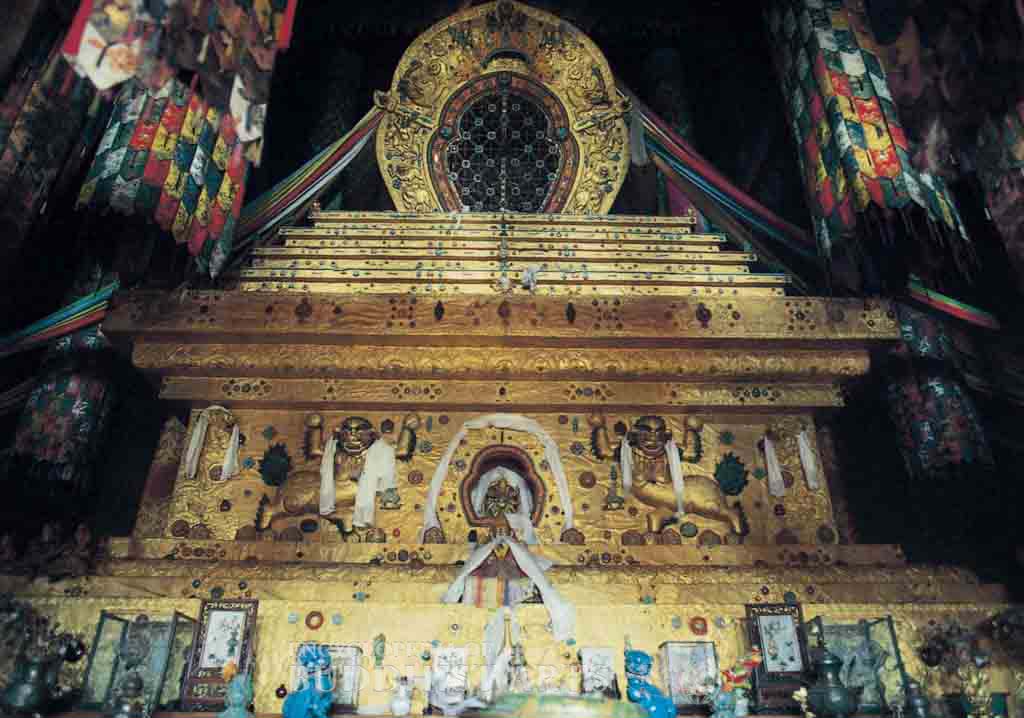
Stupa of the Thirteenth Dalai Lama by Kelsang Norbu; 20th century
Wood
Kelsang Norbu
CHINA, Tibet, Lhoka
Kelsang Norbu was born into a family of painters. His father, Letsen Yeshes Gyatso, was a well-known painter and taught him painting when he was young. By his 20’s, Kelsang Norbu was involved in several large-scale mural projects, holding the position of junior overseer, and later, chief overseer. He was called upon to replace Letsen Khyenrap, who died during the construction of the Stupa of the Thirteenth Dalai Lama, and became entrusted with the responsibility of the design and decoration of the stupa. The stupa, which was completed within three years, was so well-received that thereafter, Kelsang Norbu became the sought after artist for Buddhist works.
He studied and researched the various Tibetan decorative motifs and created many new and unique designs. In the 1930’s, Kelsang Norbu was part of a team that redesigned the Tibetan currency. These banknotes are now considered valuable collectors’ items.
Other important works include Usnisa Sitatapatra and Dharma Protector, two paintings that are compiled in the book, Tibetan Thangka. He was known to have nurtured many distinguished disciples, including his son Tenpa Rapten.
For more details, go to the Encyclopedia of Buddhist Arts: People, page 135.
Cite this article:
author = Hsingyun and Youheng and Youlu and Pokorski, Stefanie and Yichao and Mankuang and Miaohsi,
booktitle = {Encyclopedia of Buddhist Arts: People },
pages = 135,
title = {{Kelsang Norbu}},
volume = 19,
year = {2016}}