
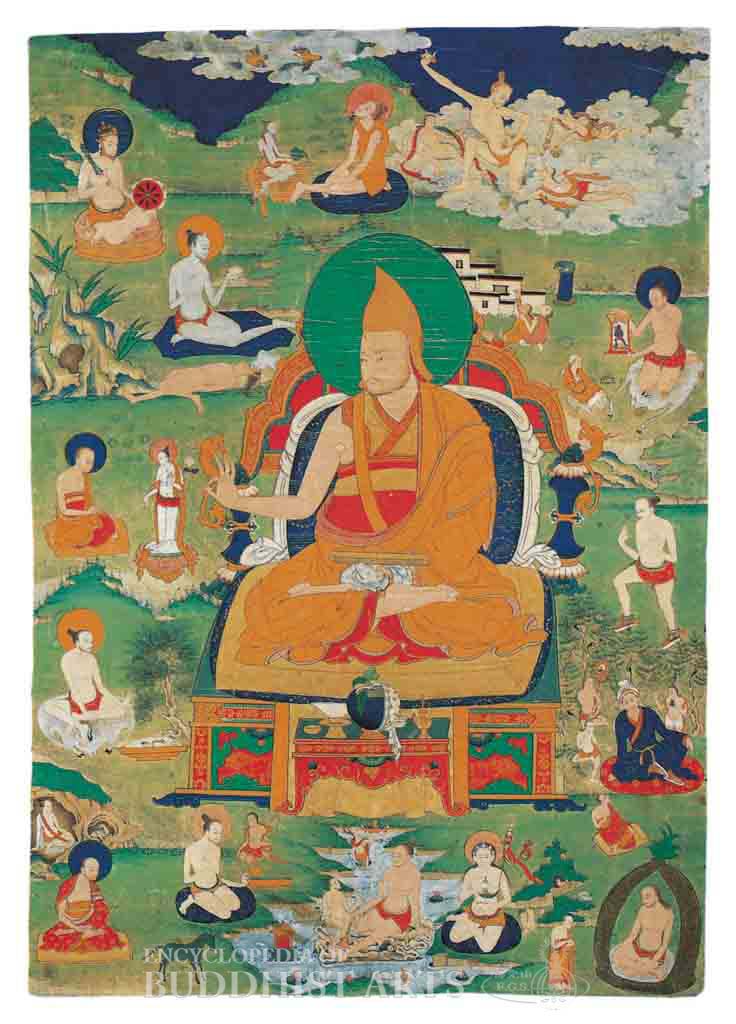
Taranatha; 17th century
Color on cloth
Taranatha
CHINA, Tibet, Shigatse
Formerly known as Kunga Nyingpo, Taranatha was a Tibetan monk, Buddhist scholar, and artist born into a family that specialized in Buddhist translation work. At the age of four, he was identified as the reincarnation of Lama Kunga Drupchok and was subsequently sent to Jonang Monastery for his education. He renounced at the age of 6, took his novice vows at 8, and received full ordination at 17.
During his teenage years, Taranatha studied various Tibetan Buddhist teachings and put forth great efforts to learn Sanskrit and master the five sciences and Buddhist canon. He also consulted and studied with teachers of different Buddhist schools from India. While serving at Jonang Monastery, he commenced a massive expansion of the complex, creating Buddha statues and formulating new monastic regulations. Taranatha later spent his time propagating and giving lectures on Vajrayana teachings. He spent six years constructing Phuntsok Ling Monastery, and invited 20 craftsmen from Nepal to help produce a large number of gold and bronze statues of the Buddha. He also gathered a group of 180 calligraphers to script precepts and commentaries in gold ink. In mourning of his mother’s passing, he created gold statues of Avalokitesvara Bodhisattva and Vajrayogini in her honor.
Taranatha wrote several books and translated many Indian classics into Tibetan. In 1608, he wrote History of Buddhism in India, the last chapter of which describes Buddhist paintings and sculptures in India, and also discusses and analyzes the influence of Kashmir arts on the Tibetan works. Taranatha is highly respected in both Mongolia and the Tibetan regions.
For more details, go to the Encyclopedia of Buddhist Arts: People, page 256.
Cite this article:
author = Hsingyun and Youheng and Youlu and Pokorski, Stefanie and Yichao and Mankuang and Miaohsi,
booktitle = {Encyclopedia of Buddhist Arts: People },
pages = 256,
title = {{Taranatha}},
volume = 19,
year = {2016}}