
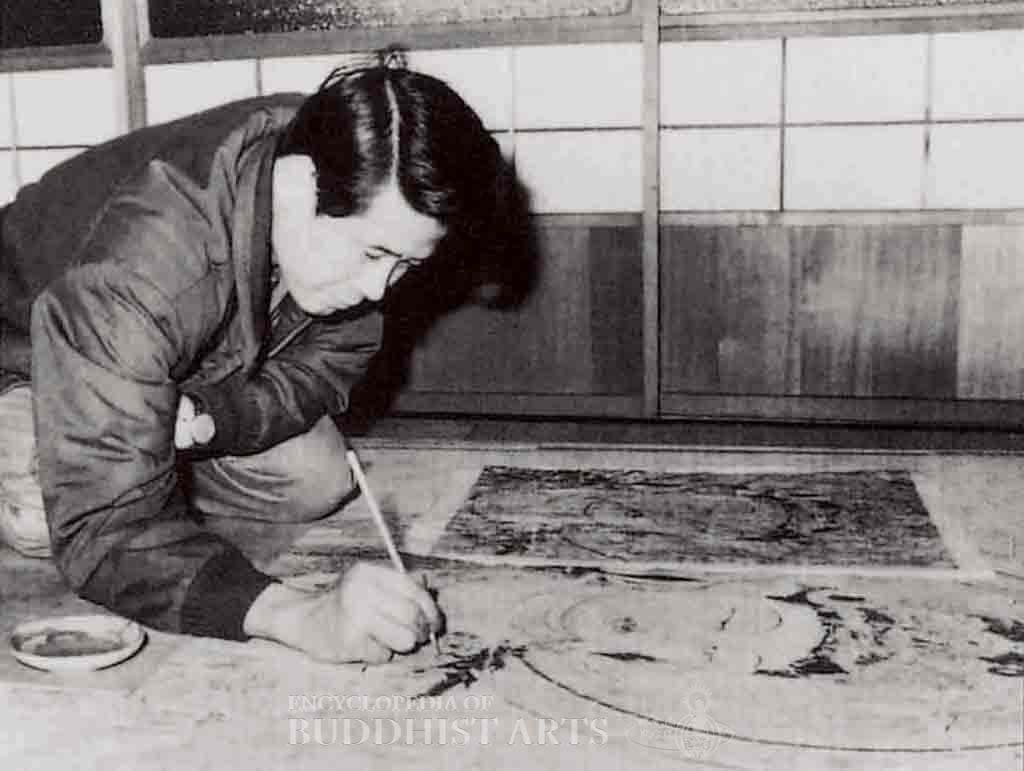
Ikuo Hirayama
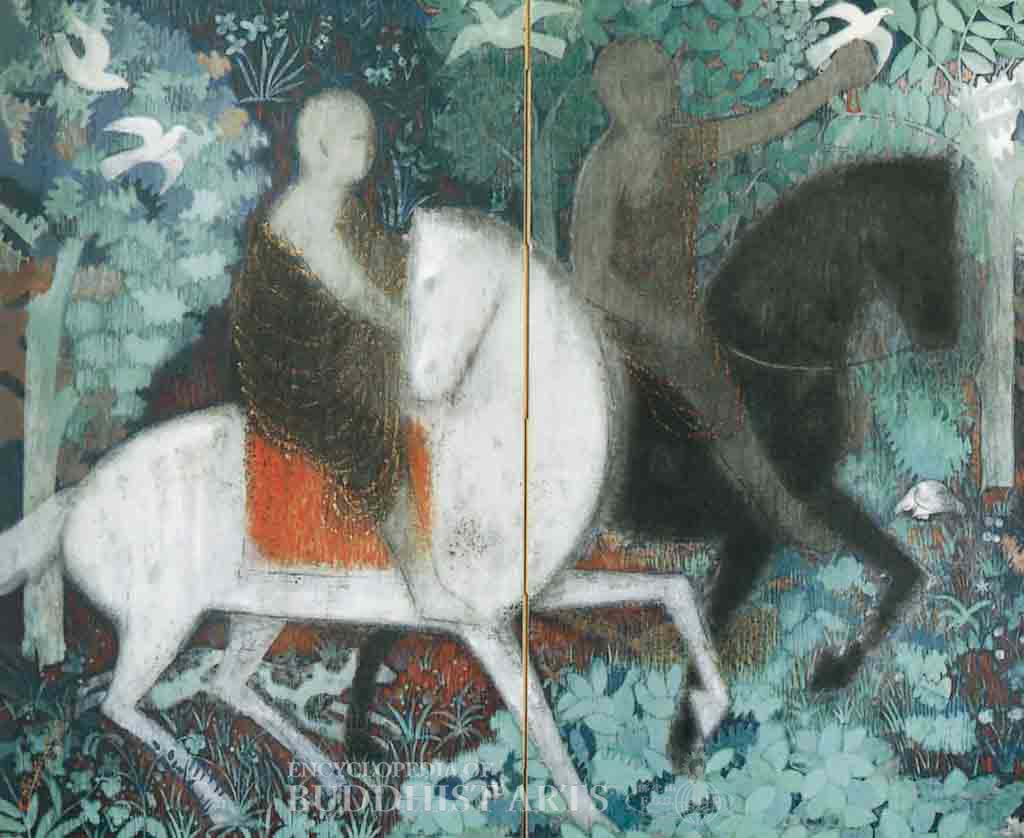
Spread of Buddhism by Ikuo Hirayama; Showa period, dated 1959
Ink and color on paper
Ikuo Hirayama
JAPAN, Hiroshima, Ikuchijima; Showa to Heisei period (1926–present)
Ikuo Hirayama, also known as Hirayama Gahaku, was a painter and educator of the contemporary era in Japan. He was admitted to the Hiroshima Shudo High School in 1945 at the age of 15, and having survived the atomic bombing of Hiroshima the same year, he went on to further his education at the Tokyo University of the Arts, studying under Maeda Seison. Ikuo later served as a foreign diplomat, and his role in promoting Sino-Japan relations and cultural exchange contributed vastly to the country. He was affectionately regarded as the Contemporary Xuanzang, after the famous Chinese monk who traveled to India and imparted cultural exchanges.
Ikuo fell ill with leukemia in 1959, likely as a residual side effect of nuclear radiation. In the face of death, his only wish was to render one painting that would leave an impact on the future generation. As he conceptualized, the image of Master Xuanzang continuously drifted into his mind, encouraging him to move forward with bravery. Therefore, his theme became Master Xuanzang, and he painted the Spread of Buddhism. The piece was subsequently selected for exhibition at the Japan Art Institution, and is collected at the Saku Municipal Museum of Modern Art in Nagano. Thereafter, the majority of Ikuo’s works were themed around the spread of Buddhism along the Silk Road.
So immersed in the research and depiction of this theme, Ikuo spent over 30 years traveling 140 times between China, Central Asia, and India for inspiration. He eventually completed the mural of the Great Tang Records on the Western Regions found in Yakushiji Temple in Nara. In addition, Ikuo’s efforts have greatly contributed to the preservation and restoration of several UNESCO World Heritage Sites including the Mogao Caves in Dunhuang, China; the Nanjing City Mural Restoration Project; the Great Buddhas of Bamiyan in Afghanistan, and Ankor Wat in Cambodia. He also produced copies of many important murals, such as those in the Golden Hall of Horyuji Temple and the Takamatsuzuka Tomb in Japan.
Ikuo’s extant works include Fantasy of Passing Into Parinirvana, Queen Maya’s Dream, Construction of Diamond Mind, and the Dirgha Agama - Fascicle 5; all of which were awarded accolades. His other paintings include Bezeklik Caves, which is kept at the Japan Foundation in Tokyo; Jetavana Monastery, collected at the Adachi Museum of Art in Shimane; West Great Buddha of Bamiyan and Dunhuang Mogao Caves, both of which are kept at Narukawa Art Museum in Hakone.
For more details, go to the Encyclopedia of Buddhist Arts: People, page 108.
Cite this article:
author = Hsingyun and Youheng and Youlu and Pokorski, Stefanie and Yichao and Mankuang and Miaohsi,
booktitle = {Encyclopedia of Buddhist Arts: People },
pages = 108,
title = {{Ikuo Hirayama}},
volume = 19,
year = {2016}}