
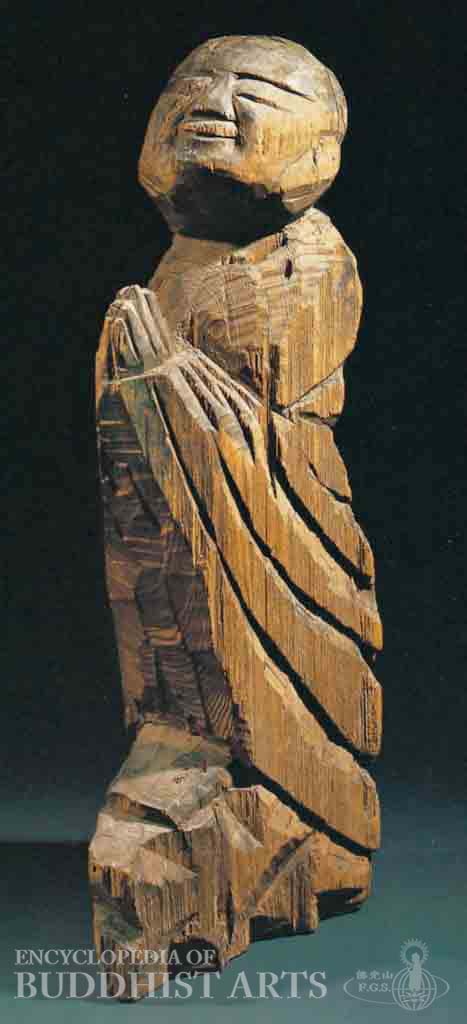
Self-Portrait by Enku; Edo period
Wood
Enku
JAPAN, Gifu; Edo period
Enku, born in Mino (present day Gifu), was a Buddhist sculptor and a Zen monk of the Rinzai school of Zen Buddhism. At the age of 23, he joined the monastic order and practiced Vajrayana Buddhism at Takadaji Temple. Enku was a recluse and often lived in caves, and thus he was commonly referred to as the Master of the Cave. He was an avid traveler, and having vowed to carve 120,000 Buddha statues during his lifetime, he would carve a Buddha statue as an offering wherever he went. Currently, over 5,000 of these statues remain extant across Japan.
With his impressive skills in carving, the sculptures he created were given exceeding vitality. Towards the end of the 14th century, professional sculptors began to lack religious sentiment in their work, a result of which caused a decline of Buddhist sculptural art. Fortunately, the unadorned sculptural style created by Enku, followed by later generation of sculptors, helped to revive the prevalence of Buddhist sculptures.
Most of the extant sculptures by Enku are collected in the cities of Mino and Aichi, and over 1,000 palm-sized Buddha statues are kept at Kannonji Temple. Other sculptures by Enku include the sculpture of Self-Portrait with his palms joined in reverence, collected at Shinmei Shrine; Eleven-Headed Avalokitesvara with Dragon Queen and Sudhana, kept at Kogajinja Shrine; Acala Triad, kept at Seiryoji Temple; and Naga Queen, collected at Miidera Temple.
For more details, go to the Encyclopedia of Buddhist Arts: People, page 62.
Cite this article:
author = Hsingyun and Youheng and Youlu and Pokorski, Stefanie and Yichao and Mankuang and Miaohsi,
booktitle = {Encyclopedia of Buddhist Arts: People },
pages = 62,
title = {{Enku}},
volume = 19,
year = {2016}}