
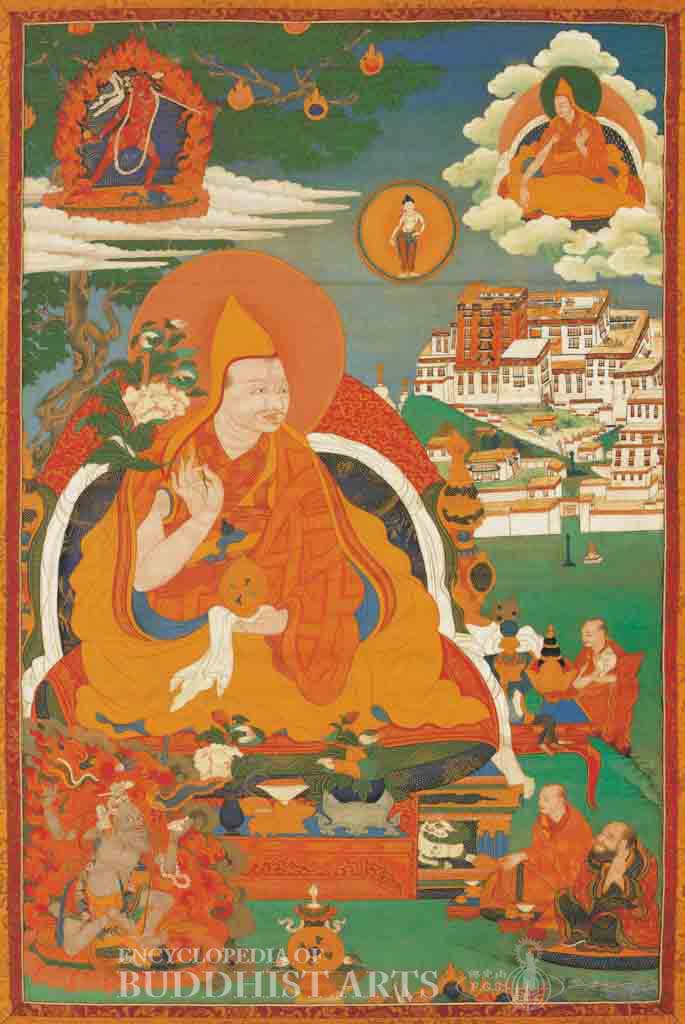
Fifth Dalai Lama Ngawang Lobsang Gyatso; Qing dynasty
Color on cloth
Fifth Dalai Lama Ngawang Lobsang Gyatso
CHINA, Tibet, Lhoka
Born Kunga Nyingpo, Ngawang Lobsang Gyatso was the Fifth Dalai Lama, and a living Buddha of the Gelug school of Tibetan Buddhism. He was recognized as the reincarnation of the Fourth Dalai Lama, and was subsequently ordained as a monk and given the name Lobsang Gyatso. Drepung Monastery became his base, where he would receive a thorough education and study the teachings of the Nyingma school of Tibetan Buddhism. Additionally, Lobsang Gyatso was an accomplished politician, scholar, and artist who studied sculpture under Zurchen Choying Rangdrol.
Recognized as one of the successors of Menla Dondrup, Lobsang Gyatso was skilled in the Menri school of sculptural art. Aside from being involved in the restoration project of the White Palace in Potala Palace between 1645 and 1648, he also sponsored numerous sculptural, painting, and thangka projects in Gelug school monasteries.
The largest monasteries in Tibet were built during the era of the Fifth Dalai Lama, a time also during which Tibetan Buddhist arts greatly flourished. Hundreds of disciples who completed their studies under Lobsang Gyatso returned to their homeland to propagate the Dharma. In addition to the spread of Gelug school teachings, the New Menri school also rapidly extended its influence to neighboring countries.
His literary works include Instructions from Manjusri, Song of the Queen of Spring, History of Tibet, Words of the Vidyadharas, Union of All Innermost Essences, and the biographies of the Third and Fourth Dalai Lamas, as well as his own autobiography.
For more details, go to the Encyclopedia of Buddhist Arts: People, page 70.
Cite this article:
author = Hsingyun and Youheng and Youlu and Pokorski, Stefanie and Yichao and Mankuang and Miaohsi,
booktitle = {Encyclopedia of Buddhist Arts: People },
pages = 70,
title = {{Fifth Dalai Lama Ngawang Lobsang Gyatso}},
volume = 19,
year = {2016}}