
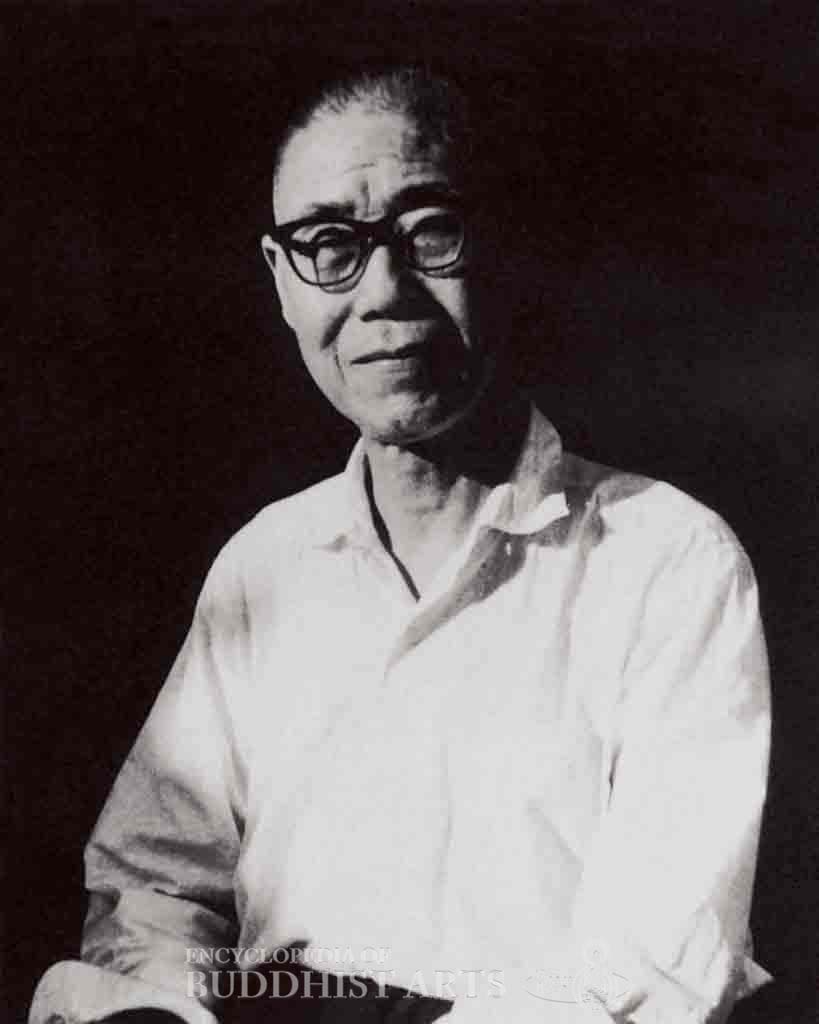
Pan Tianshou
Pan Tianshou
CHINA, Zhejiang, Ningbo
Born in Ninghai county of Ningbo, Pan Tianshou was a calligrapher, painter, and art educator who was also known as Dayi or Shouzhe. When he was young, he studied under Jing Hengyi and Li Shutong, who later became Master Hongyi, and was both highly regarded and influenced by Wu Changshuo. Among his several positions in the art field, he worked as a teacher in the Shanghai Fine Arts School, served as president of the National Chongqing College of Art, and was the vice chairman of the China Artists Association. He authored History of Chinese Painting, Collection of Pan Tianshou’s Paintings, Collection of Pan Tianshou’s Calligraphy and Paintings, and History of Chinese Calligraphy.
With an emphasis on cultivation, Pan adhered to traditional Chinese painting styles, but also experimented with various other forms of art such as folk art painting, Chinese ink painting, finger painting, poetry, and seal carving. During the Cultural Revolution, he was accused of conspiration, and as a result, he was subjected to torture and most of his paintings were destroyed. What survived is just one poem which reads, “Don’t be critical of a small cage; your mind can be as spacious as heaven and earth. The web of right and wrong is woven; since the dawn of time, people have been unjustly accused.” In 1981, ten years after his death, the Pan Tianshou Memorial Hall in Hangzhou was built to honor and exhibit his artworks.
Pan excelled in painting landscapes and figures, as well as portraying the spirit of flowers and birds, particularly his finger paintings. He often emulated the works of the Four Monastic Artists of late Ming (1368–1644) and early Qing (1644–1911) dynasties, especially that of Shitao and Bada Shanren. In his figure paintings, he often depicted these monastics. He incorporated calligraphy into his paintings, and his works in ink were impressive. The composition of his pieces are grand, peculiar, and balanced. In calligraphy, Pan was skilled in several scripts. He learned from Zhong Yao and Yan Zhenqing, and then followed the style of Northern Wei steles and other ancient scripts.
His paintings, Bodhidharma and Outdoor Sketch of Yandang Mountains, are kept at the Pan Tianshou Memorial Hall in Hangzhou. Other works include Master Daoji and the Elephant, An Old Monk Practicing Chan, Finger Painting of Bodhidharma, and the Buddhist seal, One Finger Chan.
For more details, go to the Encyclopedia of Buddhist Arts: People, page 206.
Cite this article:
author = Hsingyun and Youheng and Youlu and Pokorski, Stefanie and Yichao and Mankuang and Miaohsi,
booktitle = {Encyclopedia of Buddhist Arts: People },
pages = 206,
title = {{Pan Tianshou}},
volume = 19,
year = {2016}}