
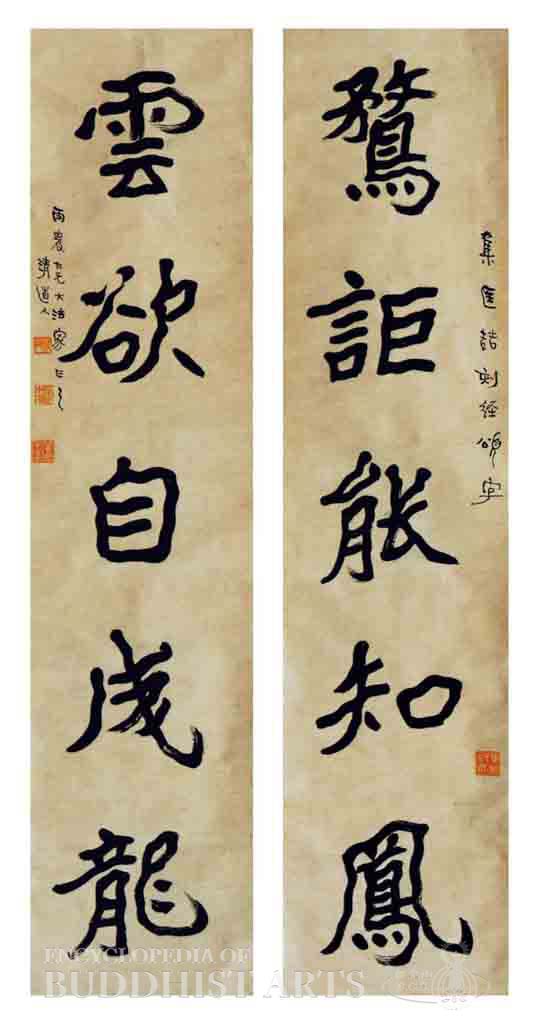
Seven-Character Couplet by Li Ruiqing; 19th–20th century
Ink on paper
Li Ruiqing
CHINA, Jiangxi, Fuzhou
Li Ruiqing, also known as Zhonglin or Qing Daoren, was an influential calligrapher, painter, and educator from Linchuan district in Fuzhou. After passing the imperial examination and becoming an Imperial Scholar in 1895, he served as a civilian intern in the Hanlin Academy, among various positions in the government. Li advocated art education and traveled to Japan to further his studies and find inspiration. After the Revolution of 1911, he moved to Shanghai and lived as a recluse. He authored four fascicles of the Remaining Collection of Qing Daoren, which are still in circulation today.
In his early years, Li learned calligraphy under various masters such as Yan Zhenqing, Liu Gongquan, and Huang Tingjian, in addition to studying the many well-known steles and tablets of the Han (206 BCE–220 CE) and Northern Wei (386–534) dynasties. His own students included the well-known artist Chang Dai-Chien.
The Stupa of Chan Master Jichan at Tiantong Temple in Zhejiang contains an inscription written by Li in regular script. Additionally, he wrote the horizontal inscribed board for Wuwei Temple in Yunnan. Incorporating calligraphy into his paintings, he was proficient in portraying landscapes, flowers, and Buddhist images. His paintings of the Buddha and Arhats were unadorned yet transcended the ordinary.
Other calligraphic works by Li include Five-Character Couplet in running script, kept at the Jiangxi Provincial Museum in Nanchang; and Two Screens in Seal Script and Clerical Script, at the Three Gorges Museum in Chongqing. In addition, his seal engraving works include the square seals of Dao Wu Yi Yuan and Huang Long Yan Zhai.
For more details, go to the Encyclopedia of Buddhist Arts: People, page 163.
Cite this article:
author = Hsingyun and Youheng and Youlu and Pokorski, Stefanie and Yichao and Mankuang and Miaohsi,
booktitle = {Encyclopedia of Buddhist Arts: People },
pages = 163,
title = {{Li Ruiqing}},
volume = 19,
year = {2016}}