
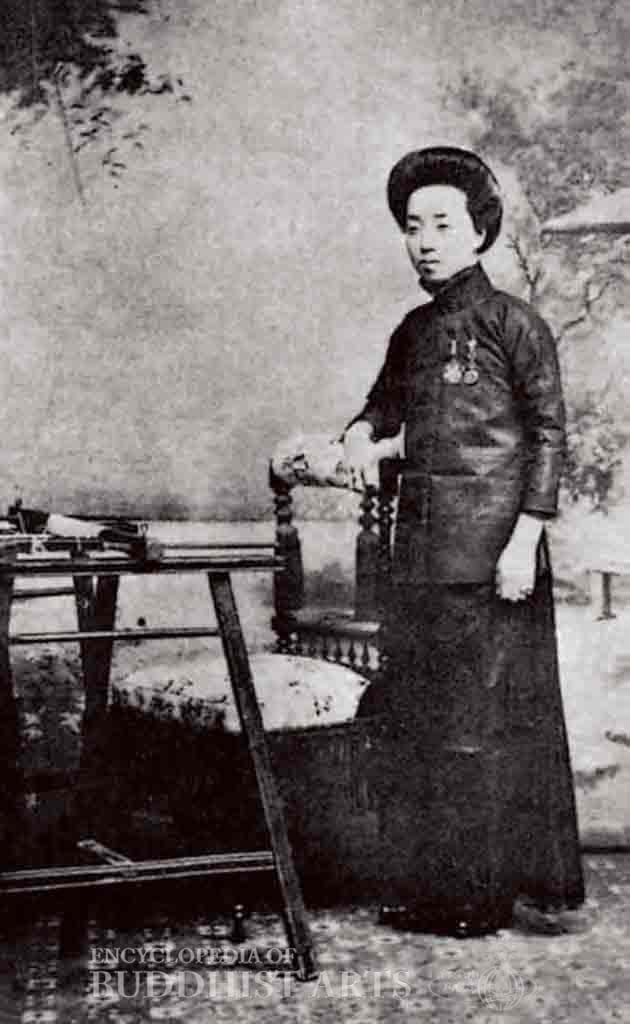
Shen Shou
Shen Shou
CHINA, Jiangsu, Suzhou
Shen Shou was an embroidery artist from Wuxian (present day Suzhou, Jiangsu). Her original name was Shen Yunzhi and she was also known as Xuejun, signing her name as Xueyi in her later years. She began embroidering at the age of 7, and was already renowned in Suzhou by age 16. She and her husband Yu Jue, a Provincial Scholar in Zhejiang, were both well-known artists in the area. Shen offered the 8 pieces embroidery work of Birthday Wishes of the Eight Immortals to Empress Dowager Cixi on her 70th birthday, and received in return two characters, “fu” (blessing) and “shou” (longevity), handwritten by the empress.
In 1905, Shen established the Imperial Embroidery School and assumed the role of chief trainer. In 1914, she was appointed to establish and head the Nantong Needlework Learning School in Jiangsu, where she taught embroidery to over 150 trainees.
Devoting her life to the development and education of her skill, Shen created over 10 different types of needling techniques. According to her narrations, politician Zhang Jian wrote a book, Xueyi Embroidery Manual, which detailed the broad art of embroidery and it’s techniques, materials, and more.
The themes of Shen’s embroidery works were varied. She was particularly adept in depicting real life figures, but was also proficient in landscapes, flowers, birds, and animals. In 1911, her embroidered portrait of the king and queen of Italy won the first prize in an international contest, allowing her world-wide acclaim. Yu Yue, a scholar of the late Qing dynasty (1644–1911), proclaimed Shen Shou as the Goddess of Needlework.
Her legacy of works are kept at the Shen Shou Art Gallery in Nantong, Jiangsu and includes Embroideries of Four Arhats, Embroidery of Avalokitesvara Bodhisattva as an Old Woman, as well as other embroideries such as Amitayus Buddha and Queen Elena of Italy.
For more details, go to the Encyclopedia of Buddhist Arts: People, page 233.
Cite this article:
author = Hsingyun and Youheng and Youlu and Pokorski, Stefanie and Yichao and Mankuang and Miaohsi,
booktitle = {Encyclopedia of Buddhist Arts: People },
pages = 233,
title = {{Shen Shou}},
volume = 19,
year = {2016}}